 Excellent PLC


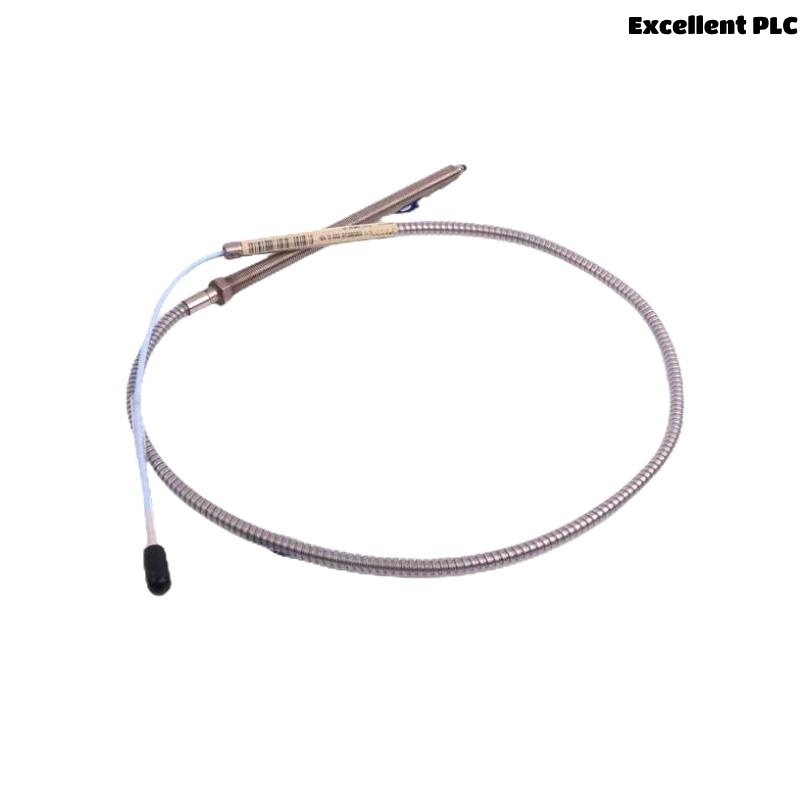
The Bently Nevada 109548-01 / P1407030-00100 NSv probe relies on precision eddy-current measurement to provide accurate shaft displacement and vibration data. While the probe itself is highly reliable, improper extension cable selection or mismatch can compromise signal linearity, bias voltage, and measurement accuracy, leading to system miscalibration and false vibration readings.
1. Problem Overview
Installation Context:
-
Probe installed on high-speed steam turbine
-
OEM recommends max cable length: 30 meters
-
Plant extended cable length to 50 meters due to relocation of junction box
-
Extension cable type differed from OEM spec (different capacitance/impedance)
Symptoms Observed:
-
DC bias voltage shifted outside normal limits (-7.5 VDC instead of -12 VDC)
-
Shaft vibration amplitude under-reported by 20–30%
-
FFT analysis showed distorted harmonic content
-
System 3500/42M protection cards triggered “Input Out of Range” warnings
-
Operators reported apparent “improved” vibration, conflicting with mechanical inspection
2. Root Cause Analysis
Through detailed inspection and signal testing:
-
Cable Impedance Mismatch
-
Extended cable had higher capacitance (~150 pF/m vs 90 pF/m)
-
Caused RC filtering effect on sensor signal → low-pass distortion
-
-
DC Bias Shift
-
Voltage drop along longer, unmatched cable reduced effective bias
-
Led to reduced eddy-current sensitivity
-
-
Linear Range Compression
-
Probe output no longer linear across specified 50 mil range
-
Misleading vibration amplitude readings
-
-
Lack of OEM Verification
-
No post-extension calibration performed
-
No verification of signal integrity using proximity tester
-
3. Diagnostic Approach
-
Bias Voltage Measurement: Confirmed DC voltage deviation
-
Loop Resistance & Capacitance Test: Identified mismatch with probe specification
-
FFT & Waveform Analysis: Verified harmonic attenuation & low-pass effects
-
Swap Test: Replacing with correct-length OEM cable restored correct baseline
4. Corrective Actions
-
Cable Replacement
-
Replaced with OEM-specified 3300XL extension cable
-
Ensured capacitance and impedance matched original design
-
-
Probe Recalibration
-
Verified DC bias voltage within -12 ±1 VDC
-
Re-established correct linear response across full 50 mil range
-
-
System Validation
-
Vibration trends returned to expected amplitudes
-
Protection cards no longer issued spurious alarms
-
Baseline validated against secondary sensors
-
5. Lessons Learned & Preventive Measures
| Lesson | Preventive Action |
|---|---|
| Cable length & type affect linearity & bias | Always use OEM-approved extension cables; do not exceed specified length |
| Post-maintenance recalibration is essential | Perform bias check and signal verification after any cable changes |
| DC bias voltage trends can indicate cable issues | Monitor bias periodically |
| Mismatched impedance acts as RC filter | Avoid substituting cable type without validation |
| FFT distortion can be caused by signal chain, not machinery | Always verify sensor path first before mechanical diagnosis |
6. Key Takeaways
-
Extending cables without verifying impedance and capacitance can create subtle, yet critical, measurement errors.
-
False improvement in vibration readings may hide real mechanical issues.
-
Correct cable selection and post-installation calibration is essential to maintain API 670 compliant monitoring reliability.
-
Even minor cable mismatches can trigger alarms or mislead operators, leading to unnecessary downtime.
Conclusion
The Bently Nevada 109548-01 NSv probe is intrinsically precise, but the signal chain, including extension cables, is critical for maintaining accuracy. Using mismatched or overly long cables introduces bias drift, amplitude attenuation, and FFT distortion. Proper cable specification, post-installation verification, and preventive monitoring ensure reliable turbine protection and vibration monitoring.