 Excellent PLC


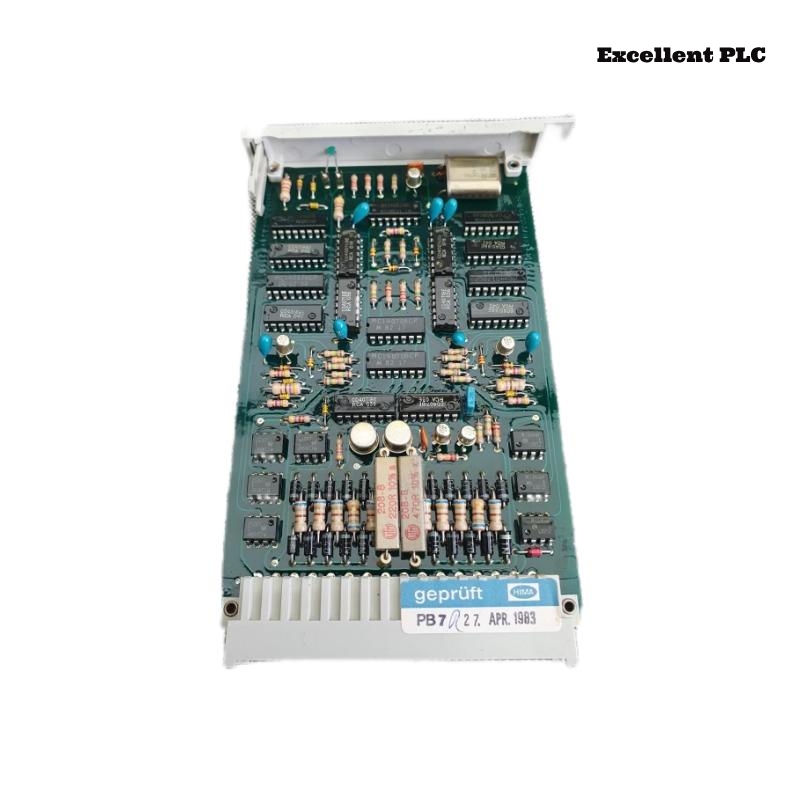
Fault Scenario
During continuous production, the F2302 module exhibited intermittent communication failures:
-
RUN LED: ON
-
SAFE LED: Flashing intermittently
-
PLC reported occasional bus timeout errors
-
Safety outputs temporarily de-energized during drop
-
Issue occurred randomly, lasting 50–200 ms
Symptoms suggested bus instability rather than full module failure.
Step 1 – Correlate Events with System Operation
-
Logged bus events and machine load cycles
-
Observed dropouts coincided with high-current actuator switching
-
Adjacent modules reported no errors during same time
Inference: Problem likely caused by electrical interference or transient voltage dips affecting F2302 bus interface.
Step 2 – Monitor Bus Signals with Oscilloscope
1. Connect differential probe to F2302 bus terminals.
2. Observe voltage waveform during machine operation.
3. Capture transient drops or glitches.
Findings:
-
Occasional voltage spikes ±3V on differential bus line
-
Spikes coincided with motor contactor switching
-
Duration: 1–2 ms → enough to cause module timeout
Step 3 – Corrective Measures
-
Separate bus wiring from high-current cables
-
Install ferrite cores or shielded twisted-pair cables on bus line
-
Add local decoupling capacitors to stabilize bus voltage near F2302
-
Validate communication stability during high-load cycles
Post-mitigation:
-
No further intermittent dropouts observed
-
PLC confirmed stable communication
-
Safety outputs maintained proper timing
Step 4 – Root Cause Analysis
-
Bus interface susceptible to transient electrical noise
-
High-current switching induced voltage spikes that temporarily disrupted module communication
-
Module functioned correctly once signal integrity restored
Step 5 – Preventive Recommendations
-
Route communication buses away from power lines
-
Use shielded and twisted-pair cabling
-
Regularly monitor bus signals, especially in high-load environments
-
Maintain proper grounding of all control and safety circuits
Engineering Insight
-
F2302 modules rely on clean bus signals; short-lived transients can cause perceived communication failures
-
Such intermittent issues are often misdiagnosed as module failure
-
Proper wiring and EMI mitigation are critical for reliable Planar F system operation
Conclusion:
If a Black Horse F2302 safety system module intermittently loses bus connection, the likely cause is electrical interference or transient voltage spikes. Cable management, shielding, and decoupling ensure stable communication and continuous safe operation in Planar F systems.