 Excellent PLC


By Thomas Reed – Senior Rotating Equipment Reliability Engineer
Background
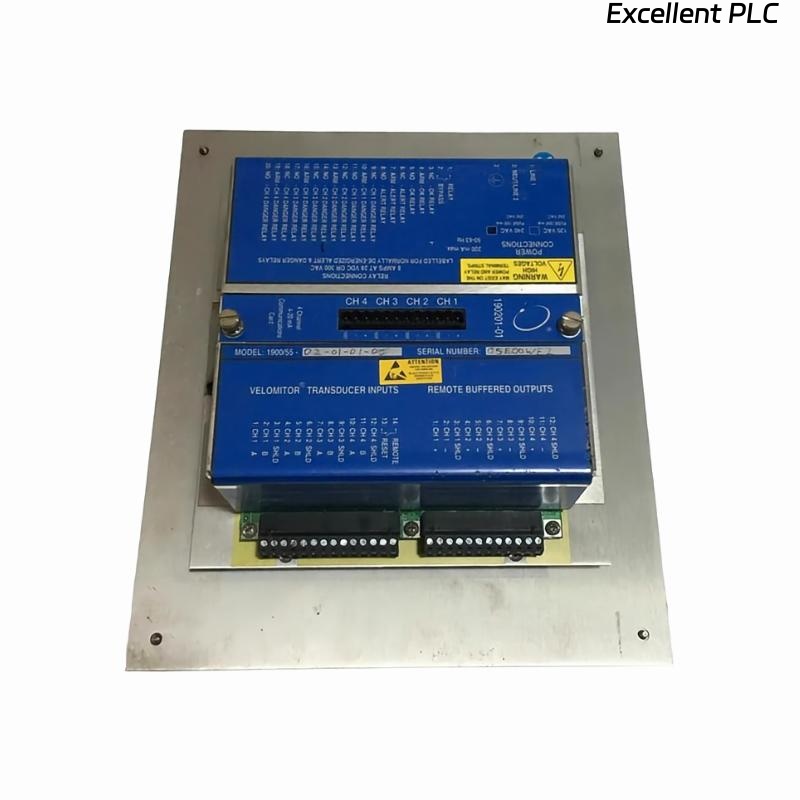
We were commissioning a high-capacity ventilation system in a petrochemical facility. The Bently Nevada 1900/55-01-02-01-01 fan monitor modules had been installed to track fan RPM and generate alarms in case of stoppage or abnormal operation.
Initial testing went well, but over the next week, operators noticed intermittent fan stoppage alarms, particularly during periods of high ambient temperature and peak load.
Symptoms Observed
-
Fan alarms triggered intermittently, lasting 2–5 seconds.
-
RPM data showed sudden drops to zero, followed by immediate recovery.
-
Multiple fans reported similar events simultaneously.
-
PLC logic for fan protection triggered shutdown commands briefly, then reset.
Visual inspection confirmed that the fans themselves were spinning normally. Bearings, blades, and motors showed no abnormal vibration or noise.
Step 1: Correlating Data
We began by correlating multiple data streams:
Analysis showed a clear pattern:
-
RPM drops coincided with voltage dips of 0.4–0.6 V in the 24 V DC supply.
-
Voltage dips occurred predominantly during high-load operation of auxiliary equipment.
-
Ambient temperatures at the fan monitor location exceeded 45°C, near the upper operating limit for module electronics.
This pointed to a combined effect of thermal stress and supply voltage fluctuations, which caused the fan monitor module to misinterpret signals and trigger false alarms.
Step 2: Module Inspection and Environmental Assessment
-
Internal temperature of the fan monitor was approaching 52°C under peak load.
-
Power terminals showed slight oxidation, increasing internal resistance and sensitivity to voltage dips.
-
Cabling was close to high-current AC feeders, further increasing susceptibility to EMI.
Conclusion: The module was operating under harsh conditions, and even minor voltage fluctuations were sufficient to cause momentary resets or misreadings.
Step 3: Mitigation Measures
-
Power Stabilization
-
Installed a dedicated regulated DC supply for fan monitors.
-
Added capacitive filtering to buffer transient voltage dips.
-
Monitored DC voltage at module terminals using DCS:
-
-
Thermal Management
-
Installed small ventilated shields around modules.
-
Added temperature monitoring to log module junction temperature.
-
Adjusted module mounting to allow airflow behind the units.
-
-
Software Filtering in PLC
-
Introduced debounce logic to ignore transient RPM drops:
-
-
Added moving average filter to smooth high-frequency spikes caused by EMI.
Step 4: Verification
Post-mitigation:
-
Monitored fan RPM and alarms during peak load, high-temperature conditions.
-
RPM signals stable; no false alarms observed.
-
PLC logic no longer triggered spurious shutdowns.
-
Logged voltage and temperature continuously to ensure operational margin.
Key Takeaways
-
High ambient temperature and supply voltage fluctuations can interact, producing faults that mimic mechanical failure.
-
Redundant data correlation is critical — RPM readings, voltage logs, and temperature monitoring allowed accurate root-cause identification.
-
PLC/DCS logic can be adapted to filter transient sensor anomalies without masking true faults.
-
Proactive module placement and thermal management extend fan monitor reliability in harsh industrial environments.
Conclusion
The Bently Nevada 1900/55-01-02-01-01 fan monitor is highly reliable, but even the best modules are vulnerable to environmental stress coupled with electrical instability.
By combining hardware mitigation, proper power conditioning, thermal management, and PLC/DCS filtering, false alarms were eliminated, and fan monitoring returned to full accuracy.
This incident reinforced a key lesson: monitoring systems are only as robust as the environment and supporting infrastructure around them.
— Thomas Reed