 Excellent PLC


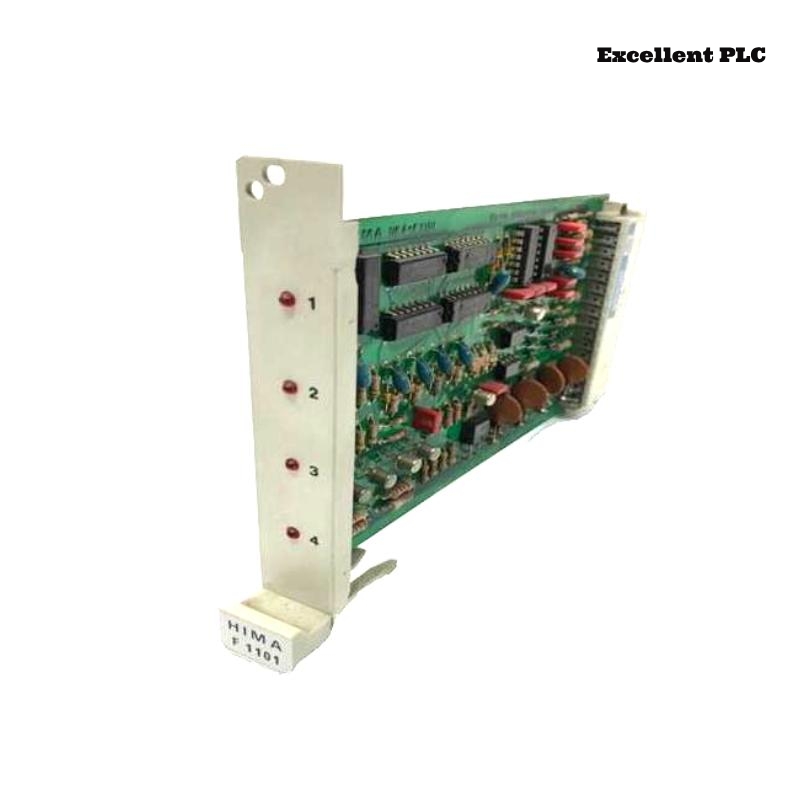
The HIMA F1101 switch amplifier module exists for a reason that is often overlooked:
safety systems do not trust the physical world as it presents itself.
To engineers coming from standard PLC backgrounds, a switch is a switch—open or closed, 0 or 1.
In a safety context, that assumption is not only naive, it is dangerous.
The F1101 sits precisely at the point where that philosophy becomes hardware.
A Switch Is Never Just a Switch
In real plants, a “simple” contact carries far more complexity than drawings suggest.
It carries:
-
mechanical bounce
-
contact oxidation
-
varying transition speeds
-
leakage currents
-
wiring resistance and induced noise
Most control systems tolerate this ambiguity.
Safety systems cannot.
The F1101 exists to translate uncertain physical behavior into a disciplined, verifiable signal.
The Role of the F1101 in a Planar F Architecture
Within the Planar F system, the F1101 does not act independently.
It functions as an interpreter between field devices and safety logic.
Its job is not amplification in the sense of strength, but amplification in the sense of clarity.
By the time a signal leaves the F1101, it has already been:
-
normalized
-
time-qualified
-
electrically isolated
-
validated against defined thresholds
Only then is it allowed to influence safety logic.
Why Timing Matters More Than State
One of the least appreciated aspects of the F1101 is its treatment of time.
A contact that closes briefly, hesitates, or chatters is not equivalent to a clean transition—even if it eventually reaches a stable state.
The F1101 observes:
-
how long a transition takes
-
whether the signal stabilizes predictably
-
whether intermediate states appear
From a safety perspective, how a signal changes can matter more than what it changes to.
This is where many “mysterious” safety behaviors originate.
The F1101 as a Filter for Human Error
Over decades of field use, the F1101 has proven to be remarkably effective at exposing mistakes that would otherwise remain hidden.
Examples include:
-
incorrect contact selection for safety duty
-
reused wiring from non-safety circuits
-
assumptions about dry contacts that are no longer true
-
mixed grounding philosophies within the same cabinet
The module does not correct these issues.
It simply refuses to ignore them.
Why the Module Feels “Too Sensitive” to Some Engineers
Engineers encountering the F1101 for the first time often describe it as unforgiving.
That perception usually comes from comparing it to permissive PLC input behavior.
In reality, the F1101 is not sensitive—it is consistent.
It applies the same criteria to every transition, every time, regardless of production pressure or operator expectation.
Once that consistency is understood, troubleshooting becomes easier—not harder.
Long-Term Stability Comes From Predictability
The most reliable Planar F systems share one trait:
the F1101 modules become boring.
No unexplained transitions.
No intermittent complaints.
No surprises during maintenance.
This does not happen by accident.
It happens when:
-
contact types are chosen deliberately
-
wiring practices are disciplined
-
environmental influences are respected
The F1101 rewards good engineering by staying silent.
Aging Effects: Rarely the Module, Usually the Loop
Over long service life, failures attributed to the F1101 are often misdiagnosed.
In practice, aging usually affects:
-
field contacts losing mechanical sharpness
-
cable insulation absorbing moisture
-
terminal pressure relaxing over time
When these changes accumulate, the F1101 becomes the first component to question signal legitimacy.
Replacing the module may temporarily mask the issue—but the underlying degradation remains.
Why Experienced Engineers Respect Switch Amplifiers
There is a reason senior safety engineers pay close attention to modules like the F1101.
They understand that safety is not enforced by logic alone, but by how confidently the system understands reality.
The switch amplifier is not glamorous.
It does not calculate.
It does not decide.
It refuses ambiguity.
A Perspective From the Field
After years of working with Planar F systems, one observation consistently holds true:
When a safety system behaves unexpectedly, the F1101 is rarely wrong—it is usually early.
As one veteran commissioning engineer put it:
“The switch amplifier doesn’t create problems.
It announces them before they become dangerous.”