 Excellent PLC


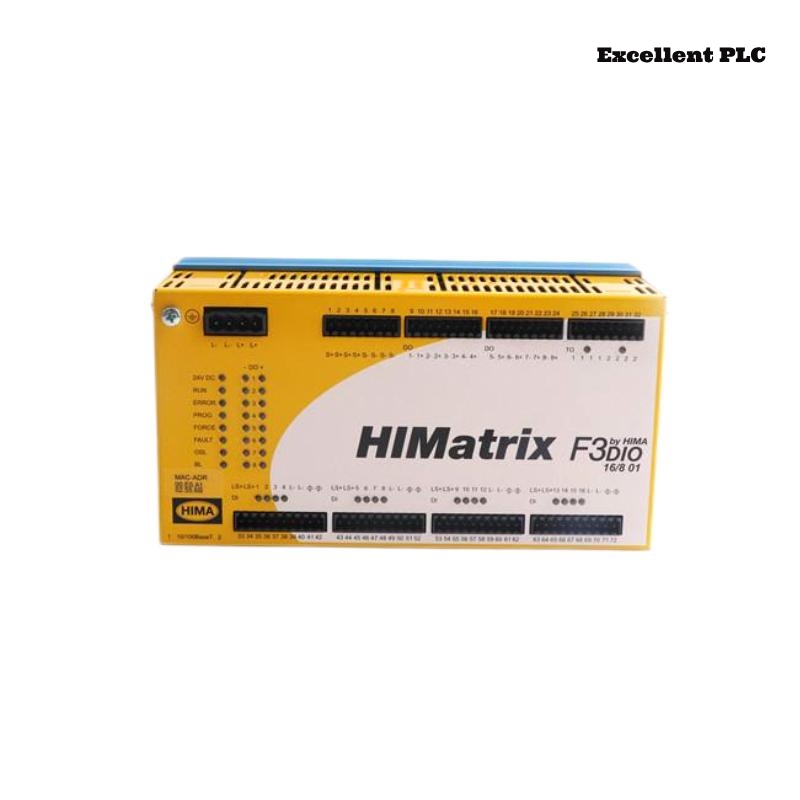
The HIMA F3 DIO 8/8 01 rarely excites anyone during design reviews.
It looks conservative.
Low density.
Almost old-fashioned compared to newer, denser I/O modules.
And yet, in plants that have been running safely for decades, this kind of module appears again and again.
Not by accident.
Longevity Changes the Definition of “Efficiency”
In project phases, efficiency is measured in cabinets, wiring, and cost.
In operational phases, efficiency is measured in:
-
speed of understanding
-
clarity during faults
-
confidence during abnormal events
The F3 DIO 8/8 01 performs well by the second definition.
Fewer Channels Preserve Signal Identity
With only eight inputs and eight outputs, each channel matters.
Engineers remember what they do.
Technicians recognize them in the field.
Drawings remain readable.
Signals retain identity instead of dissolving into density.
That identity becomes critical when time is short and stakes are high.
Simpler Mapping Reduces Cognitive Load
In abnormal situations, people do not reason perfectly.
They rely on familiarity.
The F3 DIO 8/8 01 supports that by keeping mappings simple and local.
One module.
One function group.
Clear boundaries.
This simplicity reduces mistakes—not because the system is “easier,” but because it is easier to trust.
Maintenance Reality Favors Smaller Units
Over long lifecycles, maintenance teams change.
Knowledge transfers imperfectly.
Documentation ages.
Assumptions fade.
Smaller modules survive this transition better.
When something goes wrong, the problem space is limited.
Troubleshooting becomes focused instead of exploratory.
Channel Reuse Becomes a Conscious Decision
With limited channels, reuse is not casual.
Every reassignment triggers discussion.
Is this safe?
Is this documented?
Is this temporary or permanent?
The F3 DIO 8/8 01 encourages restraint.
Restraint is underrated in safety engineering.
Failure Modes Stay Understandable
When faults occur, they tend to be isolated.
One channel.
One device.
One cause.
Dense modules blur fault boundaries.
Smaller modules preserve them.
The difference matters when diagnosing under pressure.
The Myth of “Outdated Design”
Some engineers view low-density modules as legacy solutions.
In reality, they reflect a design philosophy optimized for human reliability, not just hardware capability.
The F3 DIO 8/8 01 acknowledges a simple truth:
Systems last longer than teams.
Why These Modules Age Gracefully
Over time, processes change, but physical reality remains.
Valves still move.
Contacts still wear.
Signals still travel through copper.
The F3 DIO 8/8 01 aligns closely with that reality.
It does not abstract too much.
It does not hide complexity excessively.
As a result, aging is visible—and manageable.
A Closing Field Observation
After decades of safety system maintenance, one pattern is clear:
The systems that survive longest are not the most compact or clever ones.
They are the ones that remain understandable.
As one senior plant engineer once said during a shutdown review:
“Nothing here is fancy.
And that’s exactly why it still works.”
The F3 DIO 8/8 01 embodies that philosophy quietly.