 Excellent PLC


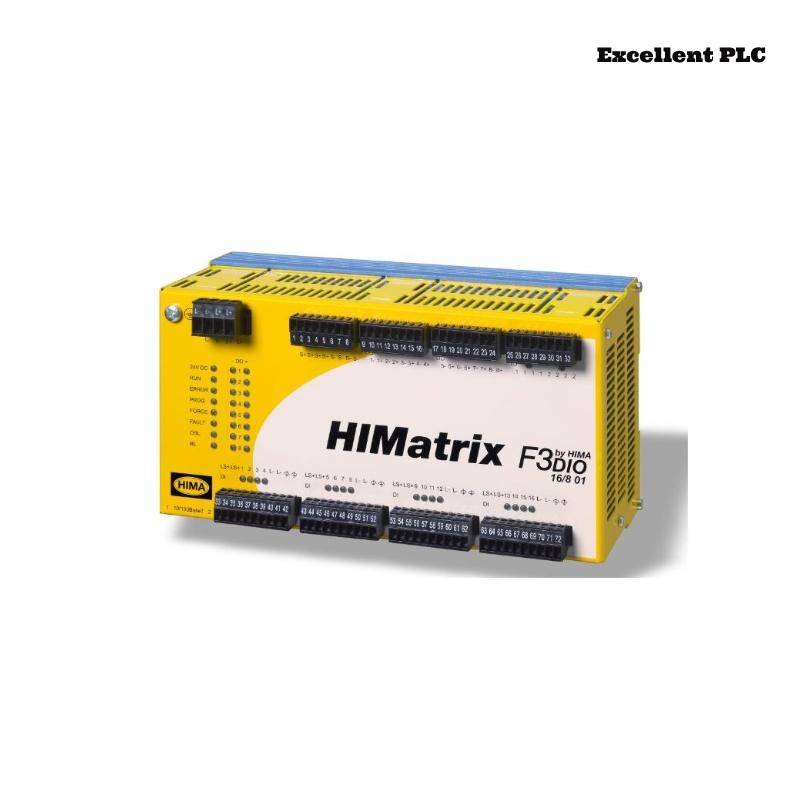
Step-by-step troubleshooting of a safety interlock activation on the HIMA F3 DIO 8/8 01 module due to cable insulation breakdown and firmware incompatibility. Includes field inspection, software updates, and preventive measures.
Incident Overview
During routine operation in a chemical processing plant, the control system unexpectedly activated a safety interlock associated with the HIMA F3 DIO 8/8 01 module. Digital output channels DO-02, DO-04, and DO-06 were immediately disabled by the module’s internal protection system, preventing connected actuators from operating.
Operators observed the HMI reporting “channel fault – safety interlock triggered” across multiple outputs. Cabinet power readings were normal, and no fire or water damage was evident. The fault, however, persisted intermittently over several hours, affecting production cycles.
Observed Fault Phenomena
-
Digital Outputs: Channels failed to energize despite correct PLC commands.
-
Digital Inputs: Certain inputs, including DI-03 and DI-05, showed fluctuating states, occasionally toggling from “active” to “unknown.”
-
Module Status LEDs: Alternated between green and red during fault periods.
-
Error Logs: Recorded “overcurrent protection activated” and “firmware protocol mismatch” events.
Initial power cycles temporarily restored operation, but the safety interlock would re-engage once batch operations involving multiple high-speed outputs were executed.
Root Cause Analysis
Field engineers identified three major contributing factors:
-
Cable Insulation Breakdown: Inspection revealed that several output wires had deteriorated insulation due to prolonged exposure to heat and mechanical vibration. This created micro-arcing and intermittent short circuits that triggered the module’s internal protection circuits.
-
Firmware Version Mismatch: A recent firmware update was applied to all other remote I/O modules in the cabinet but not to this F3 DIO 8/8 01 module. The mismatch caused communication inconsistencies with the safety controller, leading to false triggering of safety interlocks during high-speed output sequences.
-
Environmental Stress: Minor condensation inside the cabinet temporarily increased the conductivity between nearby terminals. While no water pooling was present, the elevated humidity combined with degraded insulation amplified transient currents, further activating protection mechanisms.
Additionally, rapid sequential commands from the PLC batch program increased the probability of fault occurrence, as the module firmware could not process simultaneous high-current requests on partially compromised terminals.
Step-by-Step Troubleshooting
1. Hardware Inspection and Correction
-
Power down the cabinet and lockout all affected outputs.
-
Inspect terminal connections, output wiring, and insulation integrity.
-
Replace all damaged wires and clean terminals with isopropyl alcohol to remove surface oxidation.
-
Apply protective terminal grease to prevent future oxidation.
-
Ensure all screw connections meet manufacturer-recommended torque specifications.
2. Firmware Synchronization
-
Connect to the module using HIMA Safety Configurator.
-
Verify current firmware version:
-
Update to match the latest cabinet firmware:
-
Confirm communication parameters align with the PLC safety controller.
3. Software Logic Adjustment
-
Review PLC batch routines to ensure output channels are not toggled simultaneously if high-current loads are expected.
-
Introduce minimal stagger delays (50–100ms) between sequential output commands for critical actuators:
DELAY_BETWEEN=75ms
SAVE
-
Test manually and automatically to verify outputs respond correctly without triggering interlocks.
4. Environmental Control
-
Inspect cabinet for condensation or high-humidity zones.
-
Ensure heaters and dehumidifiers are operational and maintain relative humidity below 60%.
-
If the module is located near heat-generating equipment, ensure proper airflow to avoid temperature-induced insulation degradation.
5. Validation and Monitoring
-
Restore cabinet power and monitor module over multiple batch operations.
-
Observe all inputs/outputs via HMI and log events in the diagnostic system.
-
Confirm safety interlocks no longer trigger under normal operating conditions.
After these corrective actions, the HIMA F3 DIO 8/8 01 module operated stably, with outputs responding as expected and no recurrence of intermittent faults.
Preventive Recommendations
-
Schedule regular inspection and replacement of aging wiring and insulation.
-
Keep firmware versions synchronized across all modules in the cabinet to avoid protocol mismatches.
-
Introduce periodic environmental audits of cabinet humidity, temperature, and airflow.
-
Implement PLC logic review for high-speed batch operations to prevent simultaneous high-current requests.
-
Maintain detailed logs of all inspections, firmware updates, and configuration changes for traceability.
This incident illustrates that intermittent faults and false safety interlocks often result from a combination of hardware degradation, software/firmware inconsistencies, environmental stress, and operational timing conflicts. Addressing all factors systematically ensures long-term reliability of the HIMA F3 DIO 8/8 01 module in industrial applications.