 Excellent PLC


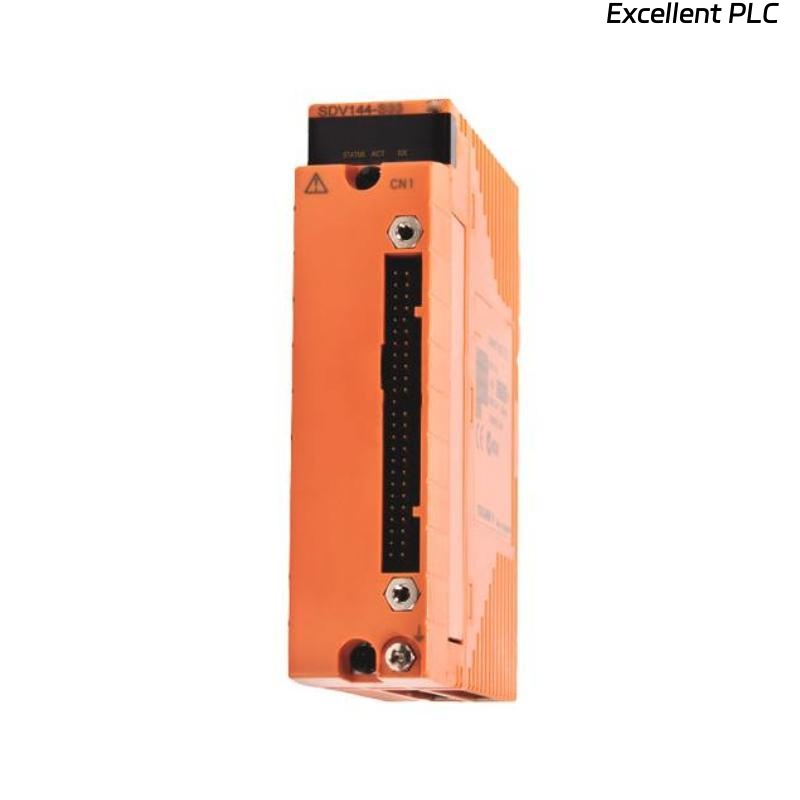
At first glance, the Yokogawa SDV144-S53 digital input module appears to perform a simple task: detect whether a field signal is ON or OFF.
In reality, its operating principle is built around trust management—deciding when a physical condition is reliable enough to become system truth.
Understanding this principle explains why the SDV144-S53 behaves conservatively, yet consistently, in real installations.
The Input Is Evaluated, Not Merely Detected
When a field signal reaches the SDV144-S53, it is not immediately treated as a logical state.
The module first evaluates the electrical condition against internal expectations.
This evaluation typically considers:
-
input voltage or current level
-
stability over time
-
reference integrity
-
channel health
Only when these conditions align does the module recognize the signal as a valid digital state.
This is why brief spikes, contact bounce, or marginal voltages often never appear in the control logic.
Internal Isolation Protects System Integrity
A core part of the SDV144-S53 operating principle is electrical isolation between field signals and the system backplane.
Isolation serves multiple purposes:
-
preventing ground loops
-
containing external surges
-
protecting internal references
-
ensuring channel independence
From the system’s perspective, isolation is not about survival—it is about maintaining clean logic boundaries.
Filtering Is Designed for Stability, Not Speed
The SDV144-S53 applies internal filtering before updating system status.
This filtering is intentionally conservative.
Its goal is not to capture every transition, but to:
-
suppress meaningless oscillations
-
avoid false alarms
-
maintain deterministic system behavior
This design choice explains why the module may appear “slow” compared to raw electrical signals, yet produces far more stable system operation.
Reference and Common Define the Meaning of ON and OFF
The SDV144-S53 does not define ON and OFF in isolation.
These states exist only relative to a valid reference and common.
If reference conditions degrade—due to grounding issues, supply instability, or wiring errors—the module may:
-
hold inputs in a safe state
-
report constant OFF
-
suppress state changes
In such cases, the module is not malfunctioning.
It is refusing to assert certainty without a trustworthy reference.
Channel Independence Is a Design Priority
Each input channel in the SDV144-S53 is treated as an independent decision point.
This means:
-
one faulty field device does not contaminate others
-
wiring issues remain localized
-
diagnostic clarity is preserved
In practice, this helps engineers trace problems to specific signals rather than questioning the entire module.
Communication With the System Is Deterministic
Once a channel state is validated, the SDV144-S53 communicates it to the system through a deterministic bus mechanism.
Timing, synchronization, and data consistency are tightly controlled.
This ensures that control logic, alarms, and sequences act on a coherent snapshot of reality.
The module does not “stream” uncertainty—it only reports what it believes to be true.
Why the Module Appears Conservative in the Field
Many engineers notice that the SDV144-S53 seems reluctant to change state under marginal conditions.
This is intentional.
The operating principle favors:
-
correctness over responsiveness
-
stability over sensitivity
-
predictability over flexibility
In a control system, these priorities reduce nuisance alarms and unsafe transitions.
A Practical Engineering Interpretation
From an engineering standpoint, the SDV144-S53 operates less like a switch reader and more like a gatekeeper.
It asks a quiet question before every decision:
Is this signal reliable enough to be trusted by the system?
Only when the answer is yes does the signal become part of system logic.
As one experienced Yokogawa engineer summarized it:
“The SDV144 doesn’t just read the plant — it decides when the plant is telling the truth.”