 Excellent PLC


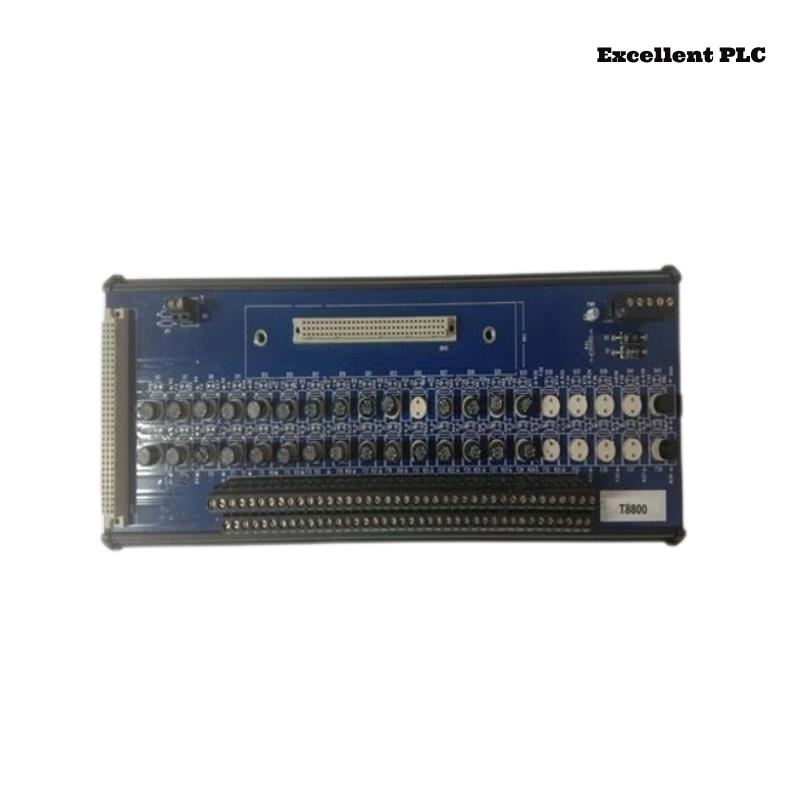
The ICS Triplex T8800 VDC digital input module looks simple.
It receives voltage.
It decides whether a signal is present.
It reports a logical state.
That simplicity is deceptive.
Because in safety systems, the real problem is not state — it is confidence.
Digital Inputs Fail Quietly
Unlike analog signals, digital inputs do not drift gracefully.
They lie.
A contact can be closed electrically but meaningless mechanically.
A voltage can be present without authority.
A signal can toggle correctly while the process behind it has already failed.
The T8800 is designed with that uncomfortable reality in mind.
Why Voltage Presence Is Not Proof
Many engineers treat digital inputs as binary truth.
24 VDC present = TRUE
No voltage = FALSE
The T8800 does not.
It evaluates whether the voltage arrives in a way that still matches expectation.
Timing, edge behavior, persistence, and coherence with other inputs matter.
A signal that looks electrically correct but behaves suspiciously is treated with skepticism.
Contact Integrity Is a Safety Question
In safety loops, contacts are rarely pristine.
They oxidize.
They bounce.
They arc.
The T8800 is deliberately intolerant of ambiguous behavior.
If a contact chatters at the wrong moment, the module does not attempt to “smooth” reality.
It escalates.
From a control perspective, this feels aggressive.
From a safety perspective, it is necessary.
The Hidden Cost of “It Still Works”
One of the most dangerous phrases in maintenance is:
“It still works.”
Digital inputs often remain functional long after they have stopped being reliable.
Temporary wiring fixes.
Aged terminal blocks.
Improvised grounding.
The T8800 frequently becomes the first component to object.
That objection is not a nuisance—it is evidence.
Why DI Problems Are Misdiagnosed
When the T8800 reports faults, engineers often suspect the module.
It is swapped.
The fault clears.
Everyone relaxes.
Weeks later, the fault returns.
The module was never the root cause.
It simply refused to tolerate ambiguity that the system had been living with for years.
Redundancy Does Not Mean Forgiveness
Redundant digital inputs are sometimes treated as backup.
“If one is noisy, the other will carry us.”
The T8800 does not work that way.
Redundancy exists to compare behavior, not to mask it.
When channels disagree, the module does not average—it questions.
Aging Cabinets Change Digital Behavior
As cabinets age:
-
grounding degrades
-
shielding becomes inconsistent
-
reference potentials shift
Digital signals still toggle, but margins shrink.
The T8800 reacts to this long before total failure.
This creates friction between operations and safety.
One wants continuity.
The other demands certainty.
What Experienced Engineers Learn to Respect
Engineers who have spent time with the T8800 learn not to argue with it.
Instead, they:
-
inspect field wiring before replacing modules
-
treat intermittent DI faults as structural warnings
-
test contacts dynamically, not statically
They understand that the module is not judging the signal—it is judging the assumptions behind it.
Digital Inputs as Safety Assertions
Every DI entering the T8800 is an assertion:
“This valve is closed.”
“This guard is engaged.”
“This condition is safe.”
The module does not accept assertions politely.
It demands consistency over time, context, and behavior.
If that consistency collapses, the module acts.
A Pattern Seen in Incident Reviews
Across multiple safety incidents, one observation repeats:
The digital input had been “slightly unreliable” for months.
The T8800 flagged it early.
Humans postponed the inconvenience.
Eventually, the process forced a decision.
As one investigator summarized it:
“The signal was not wrong on the day of the trip.
It had been untrustworthy for a long time.”
The T8800 simply refused to ignore that fact.