 Excellent PLC


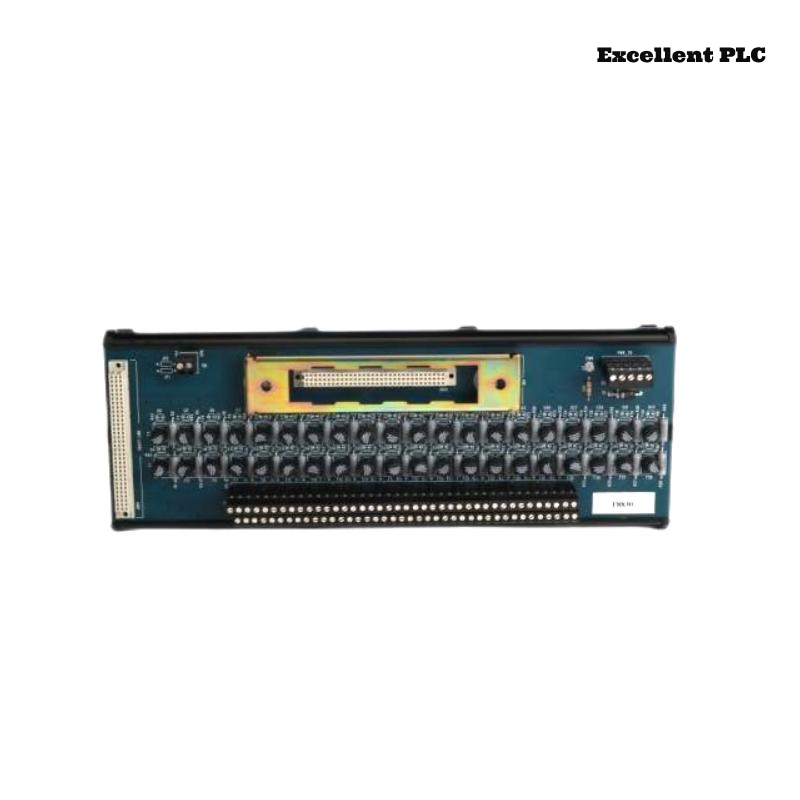
The ICS Triplex T8830 analog input module is often described in simple terms:
“It reads analog signals.”
That description is technically correct—and conceptually misleading.
In safety systems, analog values are not facts.
They are claims about reality.
The T8830 exists to decide whether those claims are believable.
Measurement Ends Where Safety Begins
In basic control systems, accuracy is the primary concern.
Better resolution.
Lower drift.
Tighter calibration.
In safety systems, accuracy is secondary.
The first question is not how precise the value is, but whether it can be trusted at all.
The T8830 is designed around this hierarchy.
Why Safety Analog Inputs Feel Conservative
Engineers new to ICS Triplex sometimes complain that the T8830 is “too strict.”
Values are rejected.
Channels fault easily.
Margins feel narrow.
This is intentional.
The module assumes that any analog signal can lie—through noise, drift, wiring damage, or sensor aging.
Its job is not to interpret generously.
Its job is to withhold confidence unless conditions are clear.
Redundancy Is About Plausibility, Not Backup
When redundant sensors are used with the T8830, many assume redundancy exists to “keep values available.”
In reality, redundancy exists to test plausibility.
Do channels agree within expected bounds?
Do changes make physical sense?
Do dynamics align with known process behavior?
Disagreement is not a nuisance—it is information.
The T8830 treats disagreement seriously.
Field Reality: Most Analog Problems Are Slow
Analog failures rarely announce themselves.
They creep.
-
insulation absorbs moisture
-
terminals oxidize
-
sensors drift gradually
The T8830 often flags issues before operators notice any process anomaly.
This creates tension.
“If the process looks fine, why is the safety system complaining?”
Because the module is judging signal integrity—not process outcome.
Why Calibration Alone Is Not Enough
Plants often respond to analog faults by recalibrating.
Sometimes this works.
Often it doesn’t.
Calibration adjusts scaling.
It does not restore trust.
If noise margins are eroding or reference stability is compromised, recalibration only hides the problem temporarily.
The T8830 will notice again.
Aging Plants Make Analog Judgment Harder
As plants age, variability increases.
Sensors age at different rates.
Process dynamics change subtly.
Environmental conditions fluctuate.
The T8830 does not adapt automatically.
What was once a comfortable signal becomes borderline.
Engineers interpret this as “the module getting worse.”
In reality, the module is unchanged.
It is the confidence gap that has narrowed.
Why Swapping the Module Feels Like a Fix
Replacing a T8830 often restores stability.
Faults clear.
Values settle.
But this is usually due to restored electrical margins—not corrected understanding.
Without addressing root causes—wiring quality, grounding philosophy, sensor suitability—the same pattern returns.
How Experienced Engineers Design Around the T8830
Veteran safety engineers respect the module’s skepticism.
They:
-
choose sensors for stability, not just accuracy
-
design wiring for noise immunity, not convenience
-
document plausibility assumptions explicitly
They understand that the module enforces judgment, not measurement.
When Analog Inputs Become Safety Arguments
Every analog value entering the T8830 is an argument:
“This temperature is real.”
“This pressure is increasing.”
“This condition is still safe.”
The module does not accept arguments politely.
It demands consistency.
When arguments weaken, it escalates.
That escalation is not failure—it is integrity.
A Reflection from Incident Analysis
Across multiple safety incident investigations, one pattern repeats:
The safety system “overreacted” only because the analog signals had been unreliable for a long time.
The T8830 noticed early.
Humans noticed late.
As one incident reviewer summarized it:
“The signal didn’t suddenly become wrong.
It slowly became unbelievable.”
The T8830 exists to draw that line.