 Excellent PLC


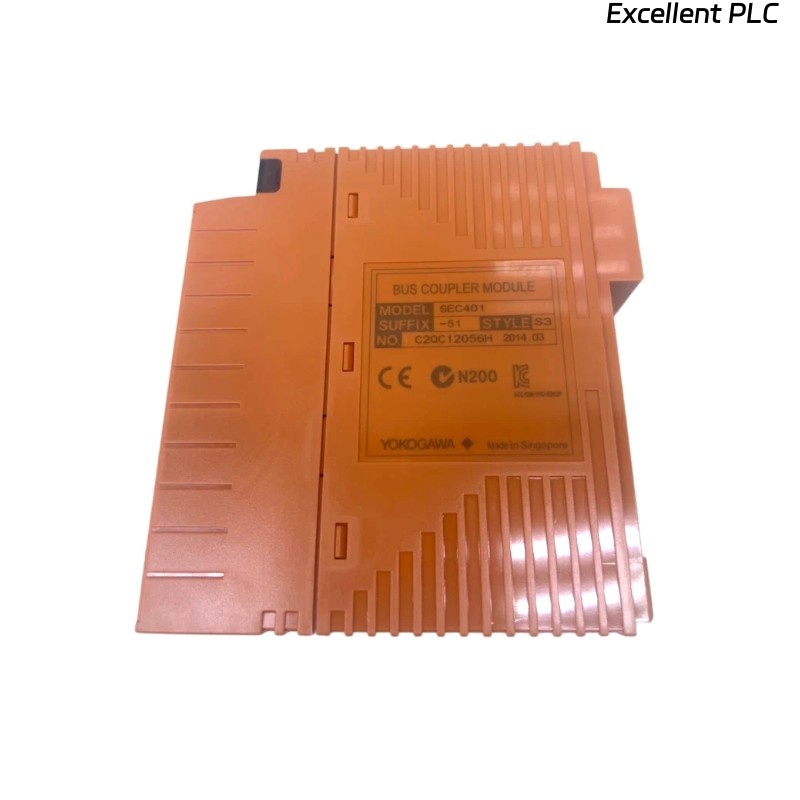
The Yokogawa SEC401-50 bus coupler module sits quietly between field I/O and the system bus, yet its installation has a disproportionate impact on overall stability.
When installed correctly, it disappears into the system.
When installed casually, it becomes the source of intermittent, hard-to-explain behavior.
Experienced Yokogawa engineers treat the SEC401-50 as a bus integrity device, not just a mechanical adapter.
Preparation Matters More Than the Physical Act of Installation
Before the module is inserted, the surrounding environment should already be considered “bus-ready.”
The backplane slot must be clean, mechanically sound, and electrically consistent.
Minor oxidation or misalignment at this interface often shows up later as sporadic communication warnings rather than immediate faults.
Power quality also matters at this stage.
The SEC401-50 may power up under marginal conditions, but initialization timing on the bus can still fail if reference stability is poor.
Mechanical Installation Is About Symmetry and Contact Quality
When inserting the SEC401-50, experienced engineers avoid speed.
The module should slide in smoothly and seat evenly across the connector.
Uneven resistance is usually a sign of guide rail misalignment or connector contamination, not a “tight” module.
A gentle reseat after initial insertion is a common field practice, not because the design requires it, but because it helps ensure uniform contact across the backplane interface.
Grounding and Reference Define Success or Failure
The SEC401-50 is extremely sensitive to grounding philosophy.
It assumes:
-
a stable reference plane
-
consistent grounding across connected modules
-
proper shield termination
Problems arise when grounding has evolved over time or when temporary maintenance grounds remain in place.
In these cases, installation appears successful, but the bus behaves unpredictably—delayed startup, intermittent dropouts, or unexplained resets.
The module is not failing; it is reacting to an environment it does not trust.
Cabling Discipline Is Part of Installation
Bus couplers amplify both good and bad cabling practices.
During installation, engineers often discover:
-
excessive cable tension at connectors
-
routing too close to power conductors
-
shield termination applied inconsistently
-
connectors reused beyond their mechanical life
Any of these can degrade signal quality enough for the SEC401-50 to flag errors, even though continuity tests pass.
Configuration Assumptions Can Block Successful Installation
Logical configuration completes the physical installation.
Installation issues are frequently traced back to:
-
bus topology mismatches
-
duplicate addresses
-
partial system updates
-
legacy configuration applied to newer hardware
From the field, it looks like an installation failure.
From the system, it is simply rejecting an invalid participant.
Typical Installation-Related Problems Seen in the Field
Without listing them as a checklist, experienced engineers repeatedly encounter:
-
modules detected but not communicating
-
bus alarms appearing only during startup
-
behavior changing with cabinet temperature
-
problems that disappear after reseating, then return weeks later
These patterns almost always point back to installation discipline rather than defective hardware.
Why Immediate Replacement Rarely Solves the Issue
Replacing the SEC401-50 may appear to fix the problem, but often only temporarily.
If grounding, cabling, or reference conditions remain unchanged, the replacement module will eventually show the same symptoms.
This is why seasoned teams hesitate to declare victory until the installation environment has been validated.
How Experienced Yokogawa Engineers Approach SEC401-50 Installation
Instead of focusing only on the module, they tend to:
-
verify ground continuity across the entire bus segment
-
inspect backplane and connectors carefully
-
review recent system modifications
-
observe behavior over temperature and time
-
treat intermittent issues as environmental clues
This approach almost always leads to a stable outcome.
A Practical Yokogawa Perspective
From long-term field experience, the most useful way to think about installing the SEC401-50 is this:
-
the module enforces bus discipline
-
installation quality defines long-term stability
-
errors usually reflect environmental inconsistency
As one senior Yokogawa engineer summarized it:
“If a bus coupler complains, it’s usually because the bus stopped behaving politely.”