 Excellent PLC


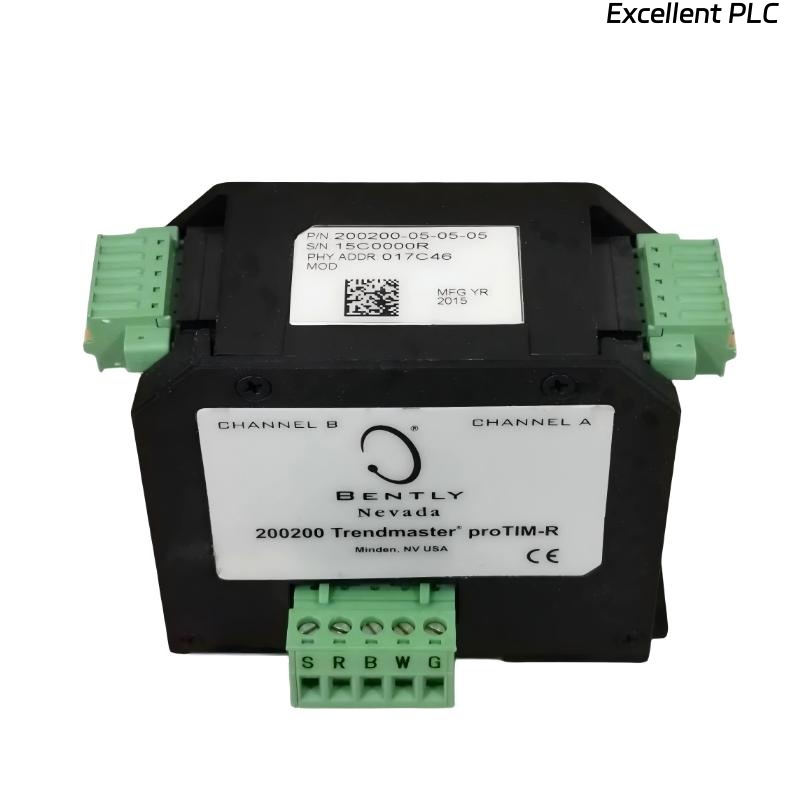
The Bently Nevada 200200-05-05 Trendmaster ProTIM-R Dual Input Module sits at a very specific layer of the machinery protection ecosystem.
It is not a front-end sensor, and it is not a high-level analytics engine.
Its value lies in accurately conditioning, digitizing, and preserving vibration information long enough for the system to make correct decisions.
When it fails—or degrades—the symptoms are often subtle, delayed, and easily misattributed.
How the ProTIM-R Dual Input Module Actually Works
At its core, the ProTIM-R Dual Input module is a signal acquisition and conditioning unit designed to handle two independent dynamic inputs, typically from proximity probes or other vibration-related transducers.
Each input channel follows the same fundamental path:
-
sensor excitation and bias handling
-
analog signal conditioning
-
filtering and scaling
-
analog-to-digital conversion
-
data transfer to the Trendmaster system
What makes this module critical is not raw processing power, but deterministic signal handling.
The module must preserve amplitude, phase, and timing characteristics accurately, even under noisy industrial conditions.
Any uncertainty introduced here propagates upward and compromises diagnostics, trends, and alarms.
Dual-Channel Design: Independent but Not Isolated
Although the module provides two input channels, they are not fully independent in every sense.
They often share:
-
reference circuitry
-
power conditioning stages
-
thermal environment
-
grounding paths
This means a problem affecting one channel can subtly influence the other—especially under marginal conditions.
Field engineers often miss this interaction when troubleshooting “single-channel” issues.
Signal Conditioning Is the Real Job
Most failures blamed on “bad sensors” eventually trace back to the conditioning stage.
The ProTIM-R module must:
-
accept low-level dynamic signals
-
reject common-mode noise
-
tolerate cable length variation
-
maintain frequency response over time
This stage is also where aging effects first appear.
Components drift long before they fail.
Where the Module Is Most Vulnerable
From long-term field experience, the ProTIM-R Dual Input module does not fail randomly.
Its weak points follow predictable patterns.
Input Front-End Sensitivity
The input circuitry is designed for precision, not abuse.
Common stressors include:
-
incorrect sensor wiring
-
accidental application of external voltage
-
hot-plugging under unstable conditions
-
ground potential differences between cabinets
Even if the module survives such events, the front-end components may degrade silently, resulting in:
-
reduced sensitivity
-
increased noise floor
-
inconsistent trend data
These failures rarely trigger immediate alarms.
Connector and Contact Degradation
Because Trendmaster systems often run for years without disturbance, connectors are rarely exercised.
Over time, this leads to:
-
oxidation at contact surfaces
-
reduced contact pressure
-
intermittent signal continuity during vibration or temperature change
When the module is finally disturbed—for maintenance or relocation—latent contact issues suddenly appear.
This is often mistaken for a “new” failure.
Thermal Aging
The ProTIM-R module is designed to operate continuously, but long-term thermal exposure matters.
Components involved in:
-
analog filtering
-
reference voltage generation
-
signal scaling
are especially sensitive to gradual thermal drift.
The module may remain operational but slowly lose measurement accuracy, leading to misleading trends rather than outright failure.
Shared Power and Reference Issues
Because dual inputs share internal references, marginal power conditions can affect both channels simultaneously.
Symptoms often include:
-
correlated noise on both inputs
-
sudden baseline shifts
-
unexplained amplitude changes
Replacing sensors in these cases does nothing.
The issue lives inside the module.
Why These Failures Are Hard to Diagnose
The most dangerous aspect of ProTIM-R degradation is that the system often continues to function.
Data still updates.
Trends still move.
Alarms may never trigger.
Only when historical data is compared—or when the machine behavior clearly contradicts the trend—does suspicion arise.
By then, the module may have been lying quietly for months.
Practical Lessons From the Field
Engineers with long Trendmaster experience tend to follow a few unwritten rules:
-
never assume dual-channel issues are independent
-
treat unexplained trend drift as a hardware symptom, not a process change
-
be cautious after any wiring disturbance
-
compare channels against known-good references periodically
Most importantly, they understand that precision modules rarely fail loudly.
A Field-Tested Perspective
After years of maintaining Trendmaster systems, one conclusion stands out:
The ProTIM-R Dual Input Module is reliable by design—but unforgiving of marginal conditions.
It does not compensate for grounding mistakes.
It does not hide connector aging.
It does not warn you when accuracy erodes.
As one senior vibration engineer once summarized it:
“When a Trendmaster module fails, it usually doesn’t stop talking—it just stops telling the truth.”