 Excellent PLC


By Daniel Foster – Senior Rotating Machinery Engineer
Industrial fans are the lifeline of many critical systems, from cooling turbines to ventilating chemical plants. Despite their apparent simplicity, the monitoring systems we rely on to ensure their reliability are sophisticated, and even small environmental or electrical deviations can trigger subtle, hard-to-detect failures.
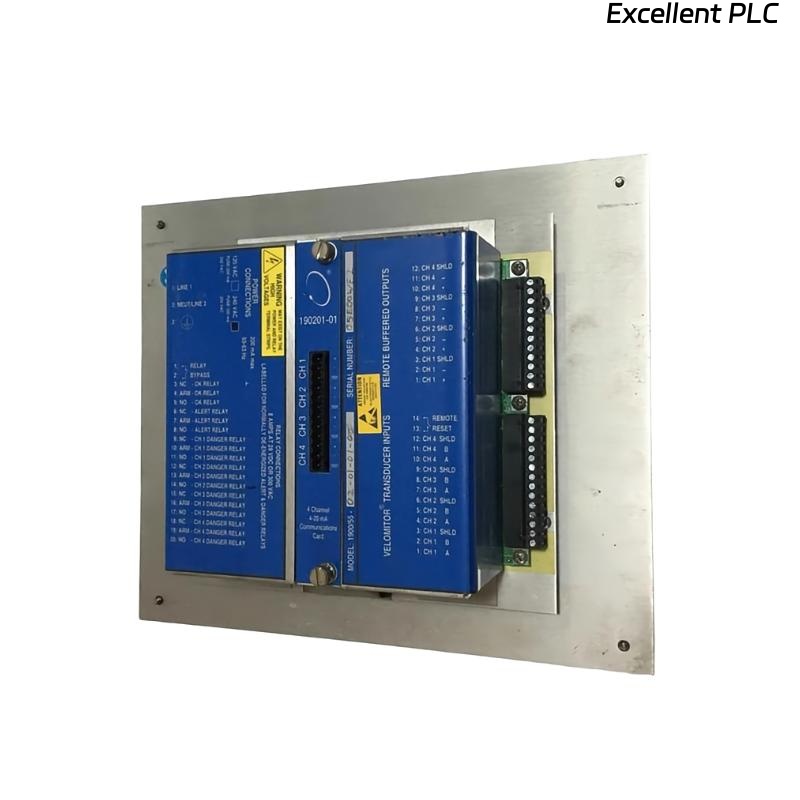
Recently, I encountered an unusual case involving a Bently Nevada 1900/55-01-02-01-01 fan monitor installed on a high-capacity industrial ventilation system. The problem was not mechanical; the fan was spinning perfectly. The issue was intermittent and electrical, manifesting as repeated module resets that disrupted accurate RPM tracking.
Initial Observations
-
Operators reported sporadic alarms indicating fan stoppage.
-
Manual inspection confirmed fans were spinning at nominal speed.
-
Historical RPM data showed repeated brief drops to zero, lasting 2–5 seconds, then recovering.
-
The pattern was irregular, affecting different fans at different times, but predominantly at peak load periods.
The irregularity suggested a systemic rather than mechanical problem. Initial hypotheses ranged from sensor misalignment, grounding issues, cable faults, to module firmware errors.
Step 1: Data Collection and Trend Analysis
I began by correlating the fan monitor outputs with plant electrical records:
-
Logged supply voltage to each fan monitor module.
-
Compared voltage deviations with timestamps of RPM drops.
-
Monitored environmental parameters: temperature, humidity, nearby machinery vibrations.
The analysis revealed that RPM drop events coincided with transient dips in the DC supply voltage, particularly during high-load operations when auxiliary motors and large pumps cycled on. Voltage fluctuations were minor (~0.3–0.5 V), but enough to trigger protective shutdowns in the monitor’s internal logic.
Step 2: Physical Inspection
-
Removed the module covers to inspect the electronics. No visible damage.
-
Checked connector integrity; all terminals secure.
-
Verified that cabling met recommended length and shielded specifications.
-
Confirmed grounding was continuous and matched manufacturer recommendations.
No mechanical or wiring faults were found. The problem appeared purely electrical, highlighting the module’s sensitivity to power quality.
Step 3: Root Cause Identification
The Bently 1900/55-01-02-01-01 fan monitor is designed with high-resolution RPM detection, but its internal microcontroller performs repeated self-tests at startup and under voltage dips. If the supply voltage drops below a critical threshold, the module initiates a protective reset, resulting in the observed brief “fan stop” events.
The combination of:
-
Electrical noise from nearby high-power equipment
-
Slightly undersized power supply wiring
-
Peak load conditions causing momentary dips
created the perfect storm for intermittent resets.
Step 4: Corrective Actions
-
Dedicated Stabilized Power Supply: Installed a regulated DC supply with low ripple and adequate current margin to serve the fan monitors independently from the main bus.
-
Power Line Filtering: Added ferrite chokes and transient voltage suppression (TVS) diodes to reduce electrical noise.
-
Cable Upgrade: Replaced undersized wiring with shielded, appropriately rated cables to reduce voltage drop during peak loads.
-
Monitoring: Implemented continuous voltage logging at the module terminals to verify stability under various load conditions.
After these changes, all previously observed RPM drops disappeared, and fan data became stable across all operating ranges.
Step 5: Lessons Learned
-
Electrical stability is as critical as mechanical integrity. Even high-quality sensors and monitors can fail intermittently if supplied with unstable power.
-
Transient events can masquerade as mechanical failure. Without careful correlation of electrical data and sensor outputs, misdiagnosis is common.
-
Preventive monitoring: Installing voltage monitoring at module inputs can preempt subtle failures before they affect operations.
-
Design review: For facilities with frequent load swings, fan monitor power circuits should be isolated from other high-current equipment to reduce the risk of induced resets.
Conclusion
The Bently Nevada 1900/55-01-02-01-01 fan monitor is robust, reliable, and capable of precise RPM monitoring. However, this case underscores that monitor reliability depends not only on the sensor itself but also on the integrity of its supporting power and environment.
Operators and engineers must treat monitoring systems as integrated components: mechanical integrity, electrical stability, environmental control, and installation practices all interact to ensure accurate, reliable data.
This incident reinforced a fundamental principle: the most sophisticated sensor cannot compensate for poor power quality. Understanding and mitigating these subtle interactions can prevent hours of troubleshooting and unnecessary component replacements.
— Daniel Foster