 Excellent PLC


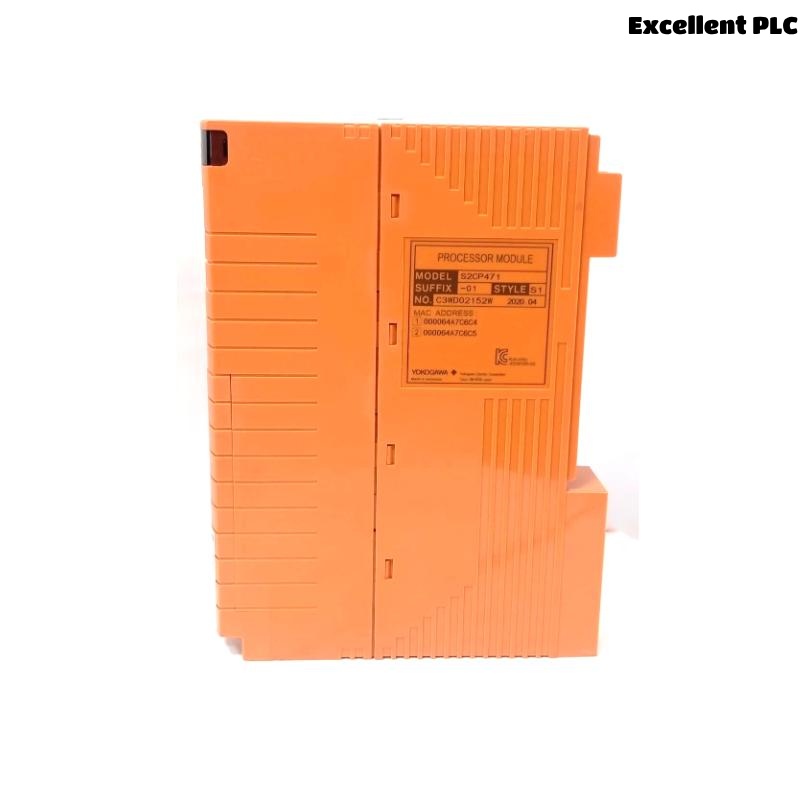
A contact short circuit involving the Yokogawa S2CP471 processor module is not a trivial fault, even if it initially looks localized.
In practice, this type of issue often exposes weaknesses in wiring discipline, grounding strategy, or long-term environmental control rather than a simple processor defect.
Engineers who have dealt with S2-series controllers know that the processor itself is robust.
When a short circuit is detected at its contact interface, it is usually reacting to something external—and doing exactly what it was designed to do.
A “Contact Short” Is Rarely an Internal Processor Failure
Despite what alarm messages may suggest, internal shorts inside the S2CP471 are uncommon.
Much more often, the processor is sensing abnormal conditions on its connected circuits.
Typical field scenarios include:
-
moisture or condensation bridging terminal contacts
-
degraded insulation on field wiring
-
conductive dust accumulation inside the cabinet
-
damaged terminal blocks creating unintended contact paths
In these cases, the processor flags the condition to protect itself and the system logic.
As one Yokogawa engineer once said:
“The CPU isn’t shorting — it’s detecting that something else already has.”
Environmental Factors Are Frequently Overlooked
Short-circuit conditions tied to processor contacts often correlate with environmental changes rather than operational ones.
Engineers commonly notice that faults appear:
-
after seasonal humidity increases
-
during night/day temperature swings
-
following cabinet door openings in dusty areas
-
after maintenance work involving compressed air
The S2CP471’s sensitivity makes it an early indicator of environmental degradation, especially in older installations.
Wiring Practices Matter More Than the Module
In many investigated cases, the root cause was traced to wiring that technically “worked” but no longer met long-term reliability standards.
Examples seen in the field:
-
wires stripped too long, exposing conductor beyond terminals
-
reused ferrules that no longer clamp properly
-
mixed signal and power wiring within the same duct
-
shields left floating or bonded inconsistently
None of these issues immediately stop the system—but all of them slowly increase the risk of contact shorts.
Why Replacing the Processor Alone Rarely Solves the Problem
Some teams respond to contact short alarms by replacing the S2CP471.
Occasionally the alarm disappears—for a while.
But if the underlying cause remains, the replacement processor is exposed to the same conditions and may eventually report the same fault.
Experienced engineers therefore treat a contact short alarm as a system-level warning, not a component failure.
How Seasoned Teams Approach Diagnosis
Rather than rushing into replacement, experienced Yokogawa technicians tend to:
-
isolate the processor from external wiring where possible
-
inspect terminal blocks under magnification
-
check insulation resistance on suspect circuits
-
clean connectors and terminals using approved methods
-
review recent environmental or maintenance changes
This approach often resolves the issue without replacing the CPU at all.
Long-Term Reliability Considerations
Once a contact short has been detected, even if it clears, many engineers take it as a sign to reassess:
-
cabinet sealing and ventilation
-
condensation control measures
-
wiring age and material quality
-
housekeeping practices inside the panel
The S2CP471 is designed to operate quietly for years.
When it raises a contact-related warning, it is usually pointing to accumulated risk rather than a sudden failure.
A Practical Engineering Perspective
From long-term field experience, the most useful way to interpret this issue is simple:
-
The processor is acting as a sensor, not a victim
-
Contact shorts usually originate outside the CPU
-
Environmental and wiring discipline determine recurrence
Or, as a senior Yokogawa specialist summarized it:
“When an S2CP471 reports a contact short, it’s time to inspect the cabinet — not just the CPU.”