 Excellent PLC


By Olivia Carter – Rotating Equipment Reliability Engineer
Fans are simple, right? They spin, they cool, and we watch them. Or at least that’s the assumption until the monitor decides to misbehave.
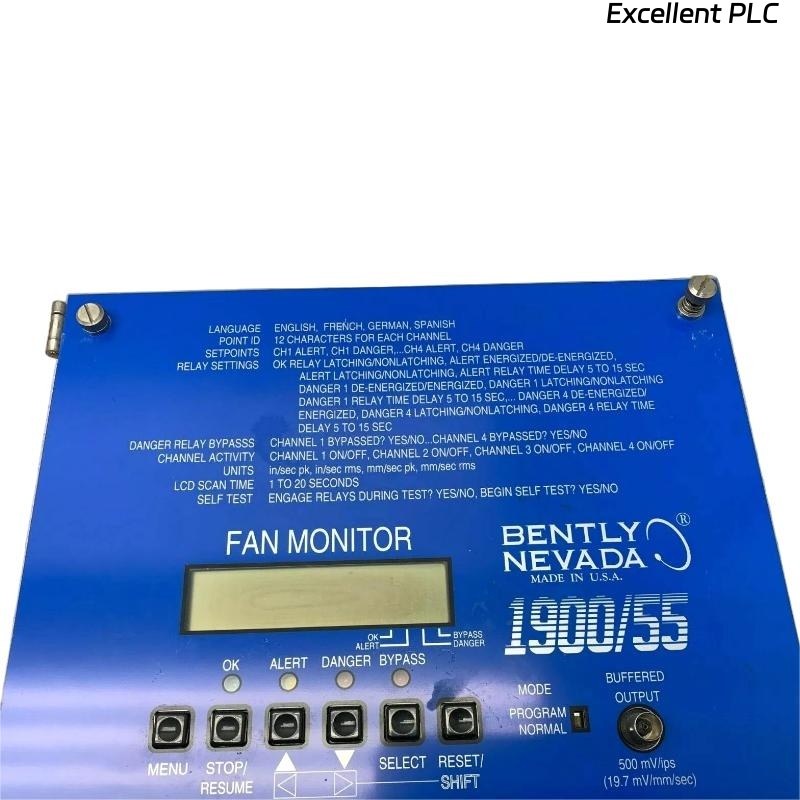
Recently, we had a Bently Nevada 1900/55-01-02-01-01 fan monitor start giving inconsistent readings on a large ventilation system in a power plant. The issue wasn’t catastrophic, but it was subtle—and dangerous if ignored.
The Symptom
-
The fan monitor intermittently showed zero RPM even when the fan was clearly spinning.
-
Sometimes the output would flicker between low and normal speeds.
-
No alarms were triggered on the control system.
Operators initially suspected a mechanical fan fault. But the fan was physically fine — bearings, blades, and motor all healthy.
The Investigation
Step by step, we looked at:
-
Sensor alignment – The monitor uses a magnetic pickup on the fan shaft. Misalignment can cause missing pulses.
-
Cable condition – A loose connector or worn shield can introduce intermittent signal loss.
-
Environmental factors – Dust, oil mist, and moisture could interfere with the magnetic signal.
Inspection revealed something subtle: the cable shield had a small crack, and the fan environment was dusty with fine metallic particles. Each fan start caused tiny vibrations that moved the cracked cable slightly, generating intermittent signal loss.
Root Cause
-
Cable degradation – The shield’s integrity was compromised.
-
Environmental contamination – Dust and metallic particles created partial short paths in the shield.
-
Vibration sensitivity – Small movements made the intermittent connection appear as fan speed loss.
The 1900/55-01-02-01-01 monitor itself was fine; it was just receiving inconsistent pulses.
Resolution
-
Replaced the damaged cable with a new shielded cable rated for high vibration and industrial dust.
-
Re-routed the cable away from areas with metallic dust accumulation.
-
Tested fan start/stop cycles for repeatable readings.
After these corrections, the monitor produced stable, accurate RPM readings.
Key Takeaways
-
Electrical signals are just as vulnerable as mechanical components.
-
Intermittent errors are often caused by wiring or environmental factors rather than the monitor itself.
-
Even “simple” devices like fan monitors need careful installation and maintenance.
-
Small details, like cable shielding and routing, make a huge difference in reliability.
Final Thought
The Bently Nevada 1900/55-01-02-01-01 fan monitor worked perfectly once it got a clean, stable signal. Never underestimate the wiring and environment — they can make a perfectly good monitor look broken.
— Olivia Carter