 Excellent PLC


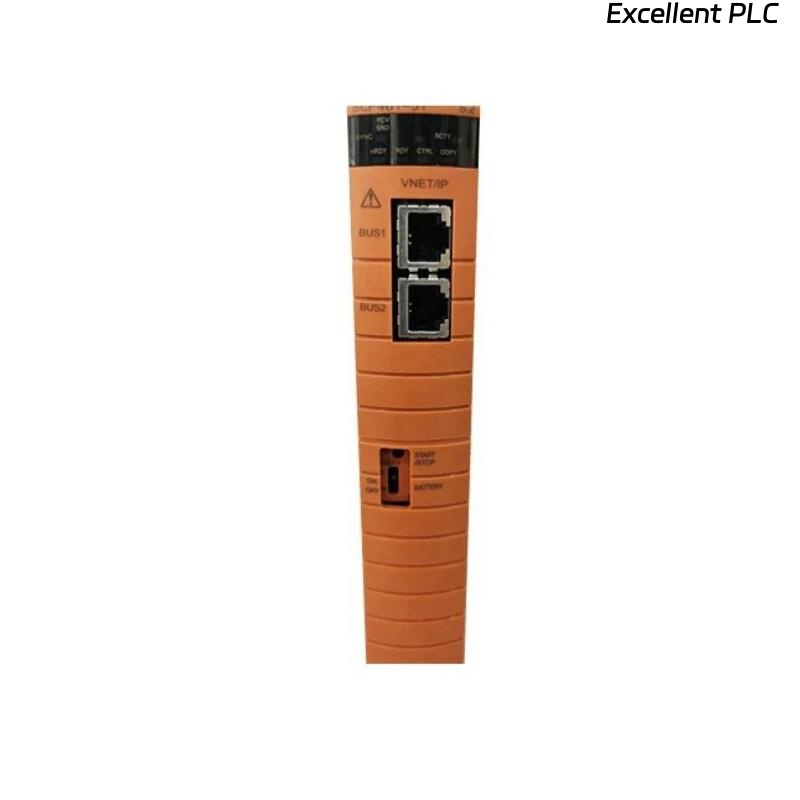
The Yokogawa CP451 CPU module plays a central role in distributed process control environments using the CENTUM platform. A frequently reported issue in complex industrial deployments is Vnet/IP communication timeout, which leads to delayed I/O updates, alarm latency, and in some cases temporary loss of control loop responsiveness. This article provides an engineering-focused analysis of this fault scenario.
1. Technical Background of Vnet/IP in CP451 Applications
Vnet/IP is a real-time industrial control communication protocol optimized for:
-
Distributed I/O exchange
-
System redundancy
-
HMI alarm/event propagation
-
Historian data reporting
-
Inter-controller communication
For deterministic control, the CP451 relies on consistent round-trip cycles between:
CPU ↔ I/O nodes ↔ Engineering Station / HMI
When communication latency exceeds threshold levels, the CP451 may report timeouts or degrade performance to fail-safe modes depending on configuration.
2. Fault Scenario Overview: Vnet/IP Timeout
A Vnet/IP timeout is typically characterized by:
-
Lost or delayed process variable updates
-
Slow alarm acknowledgement in HMIs
-
Unresponsive control loops
-
Partial or full I/O module data freeze
If redundancy is configured, switchover may occur automatically, but not all installations include a hot-standby CPU.
3. Observable Field Symptoms
Operators and maintenance engineers usually encounter the following symptoms:
(1) Operator Console Behavior
-
Trending displays appear “flat”
-
Setpoint changes take significantly longer to apply
-
Valve or actuator feedback updates lag
-
Live plant displays show intermittent data “gaps”
(2) Diagnostic Messages
Common logs include:
-
Vnet/IP Link Timeout -
I/O Node Unresponsive -
Communication Delay Detected -
Controller-to-HIS Packet Loss
(3) Hardware Indicators
On local nodes:
-
Vnet/IP LEDs flashing at unusual patterns
-
Link status intermittently dropping to “Down”
-
Node status LED switching to “Warning/Fault”
4. Root Cause Analysis
Field RCA indicates the following common contributors to communication timeout:
A. Network Congestion
-
Excess historian polling
-
SCADA burst loads during shift change
-
Overlapping OPC UA/DA requests
-
Unoptimized scan rates in ES/HIS
B. Physical Layer Problems
-
Fiber optic connector contamination
-
Ethernet cable aging or interference
-
Improper grounding introducing EMI noise
-
Faulty SFP modules on industrial switches
C. Switch & Network Design Issues
-
Incorrect VLAN segmentation
-
Lack of QoS prioritization for control traffic
-
Mixed corporate and control traffic on same segments
-
Looping topology without proper spanning-tree config
D. Firmware & Compatibility Factors
-
Mismatched firmware between CPU and I/O nodes
-
Unsupported third-party switches
-
Timing sensitivity in older firmware builds
5. Engineering Diagnostic Procedure
Recommended systematic troubleshooting steps:
Step 1 — Check Network Health
Collect:
-
Packet loss statistics
-
Switch port error counters
-
EtherType control traffic priority
-
Vnet/IP bandwidth utilization
Step 2 — Validate I/O Node Connectivity
Confirm:
-
Endpoint IP consistency
-
Node presence and uptime
-
Temperature and power supply stability
Step 3 — Perform Firmware Compatibility Check
Verify:
-
CPU firmware
-
I/O node firmware
-
HIS/ES software versions
Step 4 — Verify Physical Layer Integrity
Inspect:
-
Fiber patch panels
-
RJ45 termination quality
-
Shielding and grounding paths
Step 5 — Review SCADA / Historian Load
Audit:
-
Burst frequencies
-
Subscription counts
-
Polling intervals
-
Logging granularity
6. Recommended Corrective Actions
Short-Term Fixes
✔ Reduce SCADA/historian polling load
✔ Prioritize Vnet/IP traffic via QoS
✔ Re-seat fiber/copper network connectors
✔ Transfer non-critical traffic to alternate VLANs
Long-Term Engineering Countermeasures
✔ Implement redundant network paths with proper failover
✔ Upgrade to industrial-rated switches + SFP modules
✔ Apply Yokogawa-recommended firmware updates
✔ Establish network segmentation (Control vs IT VLANs)
✔ Design historian architecture with buffering strategy
Plants with IEC 61508 or SIL loops should enforce strict communications reliability assessments during FAT/SAT phases.
7. Preventive Maintenance Strategy
| Action | Interval |
|---|---|
| Network port error audit | Quarterly |
| Firmware compatibility check | Annually |
| Fiber cleaning & inspection | Semi-annually |
| SCADA historian polling review | Quarterly |
| Redundancy performance test | Annually |
8. Conclusion
The Yokogawa CP451 CPU module’s reliance on Vnet/IP makes network integrity a critical factor in maintaining deterministic control behavior. Communication timeouts can lead to delayed operator feedback, impaired loop control, and potential process disturbances. With disciplined diagnostics, engineered network design, and proactive maintenance, plants can significantly reduce the frequency and severity of such failures.