 Excellent PLC


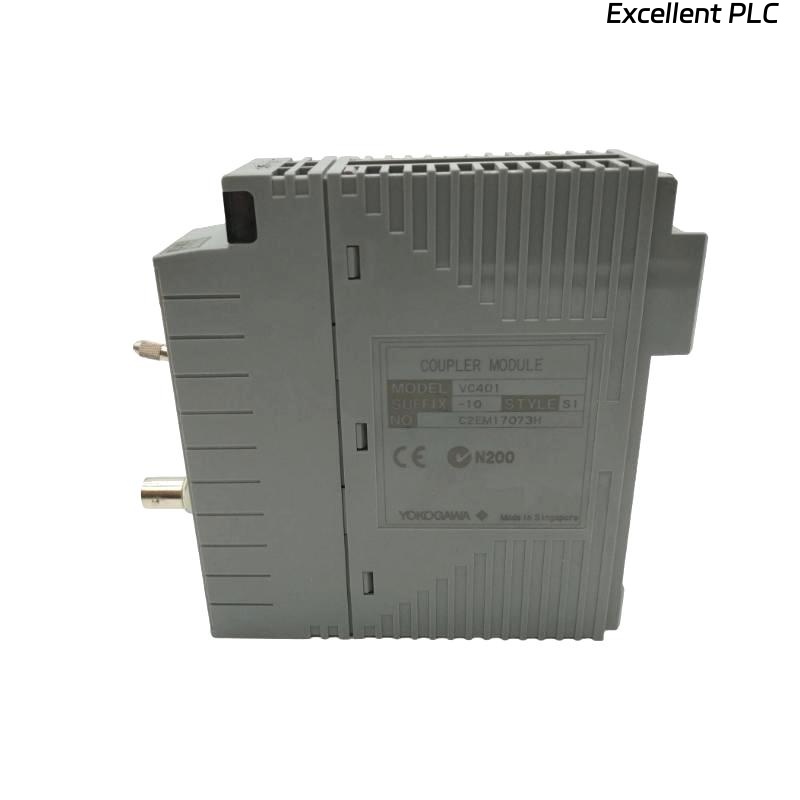
Unlike startup issues, intermittent communication failures on the Yokogawa VC401-10 Coupler Module are more difficult to diagnose. The module may appear healthy, yet the I/O station randomly goes offline or data updates become unstable.
This article focuses on non-obvious fault scenarios, diagnostic logic, and field-proven corrective actions.
1. Typical Intermittent Fault Symptoms
Engineers often report the following behaviors:
-
I/O station repeatedly switches between online and offline
-
Communication alarms appear and clear automatically
-
No visible hardware damage
-
System recovers after reboot
These symptoms usually indicate marginal conditions, not permanent failures.
2. Fault Scenario 1: Marginal Backplane Contact Resistance
Over time, connector contact resistance may increase without full disconnection.
Indicators
-
No startup issues
-
Failures worsen under vibration or temperature changes
Corrective Action
-
Reseat the VC401-10
-
Inspect for oxidation
-
Clean contacts if permitted
-
Replace backplane connector if degradation is confirmed
3. Fault Scenario 2: Ground Potential Differences
Grounding issues are a frequent but overlooked cause.
Indicators
-
Faults occur during high-load operation
-
Issues appear after system expansion
Corrective Action
-
Verify single-point grounding
-
Measure potential differences between cabinets
-
Improve grounding continuity
4. Fault Scenario 3: Bus Signal Quality Degradation
Even when wiring is intact, signal integrity may degrade.
Indicators
-
Increasing communication retries
-
No physical cable damage
Common Causes
-
Cable length near maximum limit
-
Improper termination
-
Electromagnetic interference (EMI)
5. Fault Scenario 4: Temperature-Dependent Failures
Thermal-related issues often appear after hours of operation.
Indicators
-
Failures occur only after warm-up
-
Recovery after cooling
Corrective Action
-
Improve cabinet ventilation
-
Reduce internal heat sources
-
Verify ambient temperature compliance
6. Fault Scenario 5: Firmware or Configuration Drift
Configuration mismatches may arise after maintenance activities.
Indicators
-
Faults after system updates
-
Replacement modules behave differently
Corrective Action
-
Confirm firmware compatibility
-
Re-download configuration
-
Align hardware definitions with actual modules
7. Advanced Diagnostic Strategy
A layered diagnostic approach is recommended:
Skipping steps often leads to misdiagnosis and repeated failures.
8. When Replacement Is Not the Solution
Replacing the VC401-10 without addressing root causes often results in:
-
Repeat failures
-
False confidence
-
Increased maintenance cost
Most intermittent issues originate outside the coupler itself.
Conclusion
Intermittent communication issues on the Yokogawa VC401-10 Coupler Module are typically caused by marginal electrical, environmental, or grounding conditions, rather than outright hardware failure. Understanding these subtle fault mechanisms allows engineers to stabilize system operation and avoid unnecessary replacements.
Effective troubleshooting requires pattern recognition, not guesswork.