 Excellent PLC


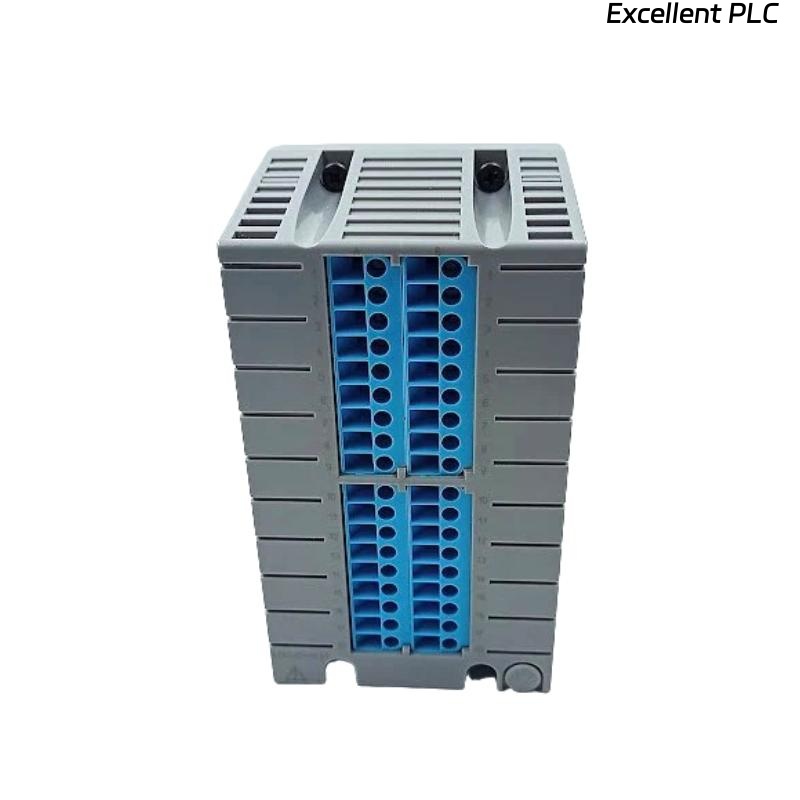
The Yokogawa ATSR3D Dual-Redundant Pressure Clamp Terminal Block is a field wiring termination assembly designed for Yokogawa CENTUM VP and CENTUM CS 3000 Distributed Control Systems (DCS). It provides secure pressure-clamp connections between redundant analog I/O modules and field instruments, ensuring reliable signal transmission in high-availability process control systems. The pressure-clamp design eliminates conventional screw terminals, reduces installation time, and improves long-term connection stability under vibration and harsh industrial environments.
Contents
- 1. Product Overview
- 2. Main Features
- 3. Typical Applications
- 4. Installation Preparation
- 5. Terminal Block Installation
- 6. Field Wiring Procedure
- 7. Wiring Verification
- 8. Commissioning Procedure
- 9. Preventive Maintenance
- 10. Practical Installation Case
- 11. Frequently Asked Questions
Product Overview
The ATSR3D functions as the field termination interface for redundant analog I/O systems. It connects field transmitters, sensors, and actuators to Yokogawa redundant I/O modules while maintaining dependable electrical connections. The pressure-clamp mechanism provides uniform contact force, minimizes wiring errors, and simplifies maintenance without requiring periodic screw tightening.
Main Features
- Supports dual-redundant analog I/O systems
- Pressure-clamp terminal technology
- Fast tool-assisted wiring installation
- High resistance to vibration and shock
- Reliable long-term electrical contact
- Maintenance-friendly terminal design
- Industrial-grade insulation materials
- Compatible with Yokogawa CENTUM FIO systems
Typical Applications
- Redundant analog input systems
- Redundant analog output systems
- Pressure transmitter wiring
- Flow measurement loops
- Temperature transmitter connections
- Level measurement systems
- Oil and gas facilities
- Power generation plants
Installation Preparation
- Verify the ATSR3D model number.
- Inspect the terminal block for shipping damage.
- Review field wiring diagrams.
- Prepare labeled instrumentation cables.
- Verify cabinet grounding.
- Disconnect cabinet power before installation.
- Prepare appropriate wire stripping tools.
Terminal Block Installation
- Turn off cabinet power.
- Install the ATSR3D onto the designated mounting base.
- Verify the locking mechanism is fully engaged.
- Connect the interface cable to the redundant I/O module.
- Inspect connector alignment.
- Verify secure mechanical installation.
- Confirm proper seating before wiring.
Field Wiring Procedure
- Strip conductors to the recommended length.
- Insert each conductor completely into the pressure-clamp terminal.
- Verify terminal numbering against wiring drawings.
- Use shielded instrumentation cables where required.
- Ground cable shields at one end only.
- Separate signal wiring from power cables.
- Label every field signal connection.
Wiring Verification
- Verify terminal assignments.
- Check conductor retention.
- Inspect connector engagement.
- Measure cable continuity.
- Verify shield grounding.
- Inspect overall cable routing.
Commissioning Procedure
VERIFY TERMINAL INSTALLATION
CHECK CONNECTOR ENGAGEMENT
VERIFY FIELD WIRING
MEASURE LOOP CONTINUITY
APPLY CABINET POWER
VERIFY REDUNDANT I/O OPERATION
TEST FIELD SIGNALS
CONFIRM NORMAL SYSTEM OPERATION
Preventive Maintenance
- Inspect pressure-clamp terminals regularly.
- Verify conductor retention.
- Inspect interface connectors.
- Maintain cabinet cleanliness.
- Verify grounding integrity.
- Perform routine loop inspections.
Practical Installation Case
During the upgrade of a refinery emergency shutdown system, ATSR3D terminal blocks were installed with redundant analog input modules monitoring critical pressure and level transmitters. After wiring verification, continuity testing, and redundant channel validation, all process signals were transmitted reliably. The pressure-clamp design shortened installation time and improved maintenance efficiency during future shutdowns.
Frequently Asked Questions
What is the primary function of the ATSR3D?
The ATSR3D provides pressure-clamp field wiring termination for Yokogawa dual-redundant analog I/O systems, ensuring reliable electrical connections between field instruments and redundant control modules.
Does the ATSR3D require periodic screw tightening?
No. The pressure-clamp mechanism automatically maintains conductor contact pressure, eliminating the need for routine screw tightening.
Can the ATSR3D be used in standard non-redundant systems?
Although physically similar to standard terminal blocks, the ATSR3D is intended for redundant analog I/O applications and should be used according to the Yokogawa system design and wiring documentation.
Summary
The Yokogawa ATSR3D Dual-Redundant Pressure Clamp Terminal Block provides secure, vibration-resistant, and maintenance-friendly field wiring for redundant analog I/O systems. Proper installation, accurate field wiring, and regular inspection help ensure reliable signal transmission and high system availability in Yokogawa CENTUM Distributed Control Systems.