 Excellent PLC


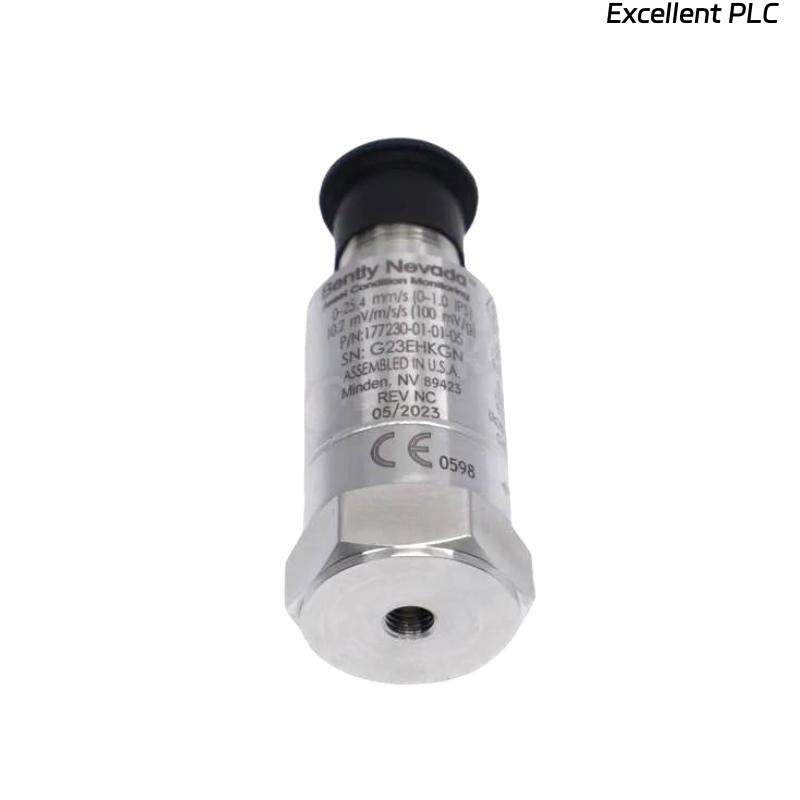
Table of Contents
- Bently Nevada 177230-01-01-00 Troubleshooting Entry
- Signal Behavior and Fault Symptoms
- Fault Diagnosis Logic for Seismic Sensors
- Root Causes of Measurement Errors
- Real Case: EMI-Induced Signal Fluctuation
- Recovery Strategy and Optimization
- FAQ
- Technical Summary
Bently Nevada 177230-01-01-00 Troubleshooting Entry
Bently Nevada 177230-01-01-00 seismic sensor troubleshooting shows that abnormal 4–20 mA outputs—such as signal fluctuation, constant baseline, or incorrect vibration levels—are primarily caused by installation, wiring, or environmental interference rather than sensor hardware failure.
This guide applies a structured fault diagnosis method based on signal behavior and field experience.
Signal Behavior and Fault Symptoms
- Constant 4 mA output (no vibration detection)
- Fluctuating signal under steady machine conditions
- Signal saturation near 20 mA
- Intermittent signal drop
Each symptom indicates a specific failure mechanism.
Fault Diagnosis Logic for Seismic Sensors
IF 4 mA constant:
    check sensor mounting
    verify loop wiring

IF signal fluctuates:
    inspect grounding
    check EMI interference

IF signal saturated:
    verify vibration range
    check scaling configuration

IF intermittent signal:
    inspect connectors
    check power stability
This diagnostic logic minimizes unnecessary sensor replacement.
Root Causes of Measurement Errors
- Poor mechanical coupling reducing vibration transmission
- Electromagnetic interference from nearby motors or cables
- Incorrect wiring polarity or loose connections
- Power supply instability
Real Case: EMI-Induced Signal Fluctuation
In a blower system, vibration signal fluctuated between 6–14 mA despite stable mechanical operation.
Observed Data:
- Noise correlated with motor startup cycles
- Signal cable routed parallel to power cable
Analysis: External interference suspected.
Root Cause: Electromagnetic interference (EMI) coupling into signal loop.
Solution:
- Separated signal and power cables
- Improved shielding and grounding
Result: Signal stabilized at 8–10 mA with consistent vibration readings.
Recovery Strategy and Optimization
- Ensure rigid sensor mounting
- Use shielded cables with proper grounding
- Maintain stable loop power supply
- Perform periodic signal validation
Preventive diagnostics improves system reliability.
FAQ
Why is the signal unstable?
This is typically caused by EMI or grounding issues.
How to confirm sensor accuracy?
Compare output with a portable vibration analyzer.
Is hardware failure common?
No, most faults are related to installation or wiring.
Technical Summary
This Troubleshooting Guide demonstrates that Bently Nevada 177230-01-01-00 faults are mainly caused by installation quality, wiring integrity, and environmental factors. A structured fault diagnosis approach ensures accurate and stable vibration monitoring.