 Excellent PLC


Contents
- Device Profile
- Role in the Automation System
- Pre-Installation Checks
- Controller Mounting Procedure
- Electrical and Interface Connections
- Commissioning Process
- Technical Recommendations
Device Profile
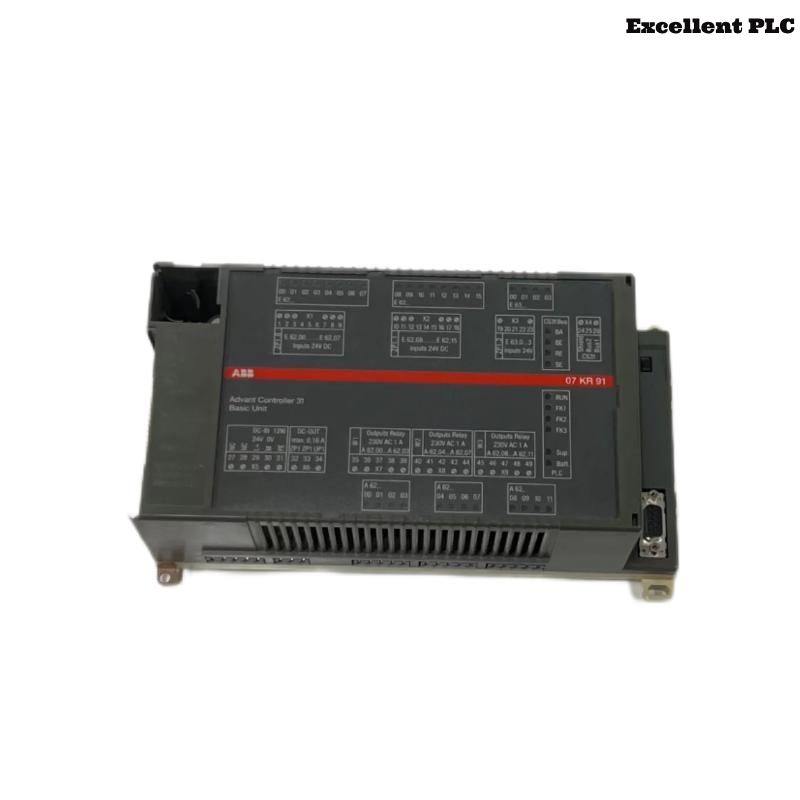
The ABB 07KR91B PLC controller is part of the ABB Procontic automation family and serves as the central processing component responsible for executing control logic and managing connected I/O modules.
This controller integrates communication interfaces, CPU processing functions, and system monitoring capabilities. It is typically installed in industrial control cabinets where reliable automation control is required.
Role in the Automation System
Within the Procontic PLC architecture, the 07KR91B module coordinates system operations and ensures that control programs interact correctly with field devices.
Its primary responsibilities include:
- Executing PLC programs controlling industrial processes
- Managing digital and analog signal modules
- Handling communication between engineering software and PLC hardware
- Monitoring system diagnostics and operational status
Proper installation ensures stable data exchange between the CPU and peripheral modules.
Pre-Installation Checks
Before installing the PLC controller, verify that the installation environment meets recommended conditions.
- Ambient operating temperature between 0°C and 50°C
- Relative humidity below 85%
- Control cabinet properly grounded
- Adequate ventilation to prevent overheating
Prepare the following installation tools:
- Insulated screwdrivers
- Electrical tester or multimeter
- Anti-static wrist strap
- Approved industrial communication cables
Controller Mounting Procedure
Preparation Phase
- Turn off the main power supply to the PLC cabinet.
- Confirm that no voltage is present on the mounting rail.
- Inspect the DIN rail or mounting frame for secure grounding.
Module Installation
- Position the 07KR91B controller on the DIN rail or rack location.
- Slide the module into position until the connector engages.
- Lock the module in place using the mounting latch.
- Verify alignment with neighboring modules.
A secure mechanical connection ensures stable communication across the PLC system.
Electrical and Interface Connections
After mechanical installation, proceed with the electrical wiring.
- Connect the recommended power supply to the PLC terminals.
- Verify correct voltage levels before energizing the system.
- Attach communication cables used for programming and diagnostics.
- Route signal cables separately from high-power electrical lines.
These wiring practices help minimize electrical noise and signal interference.
Commissioning Process
Once the controller is wired correctly, the PLC system can be powered on and initialized.
POWER_ON_CONTROLLER
CHECK_CPU_STATUS
DETECT_IO_MODULES
VERIFY_SYSTEM_CONFIGURATION
DOWNLOAD_APPLICATION_PROGRAM
If the controller successfully detects all installed modules and begins executing the program, the installation process is complete.
Technical Recommendations
- Clearly label all PLC modules and wiring.
- Maintain updated system configuration documentation.
- Back up PLC programs regularly.
- Monitor controller LEDs during startup.
- Perform routine inspection of connectors and wiring.
Following these guidelines ensures reliable installation and long-term operation of the ABB 07KR91B PLC controller in industrial automation environments.