 Excellent PLC


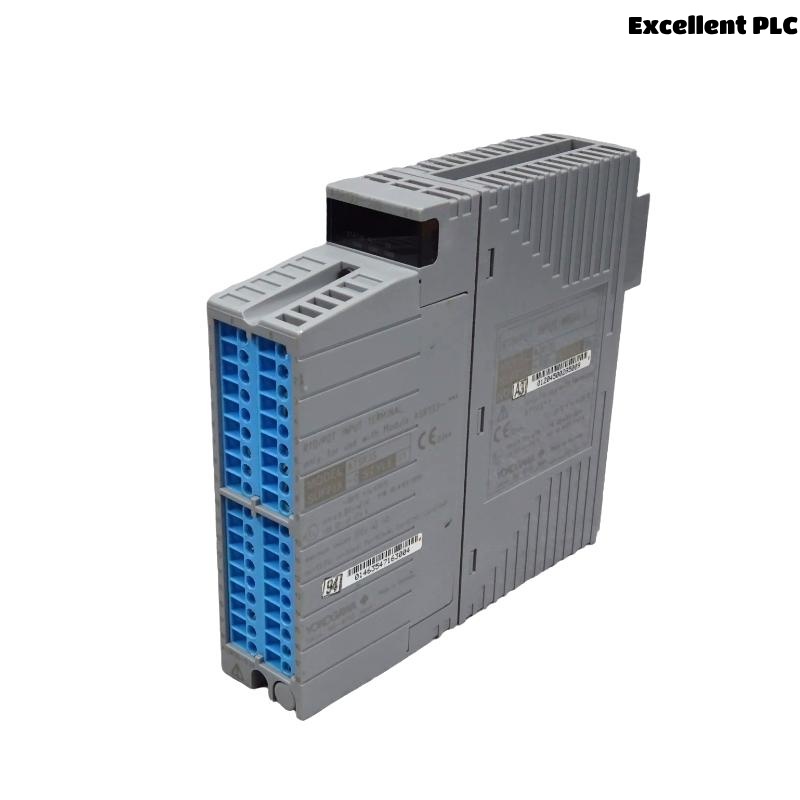
The Yokogawa ASR133 RTD/POT Input Module is an 8-channel isolated analog input module designed for Yokogawa CENTUM VP and CENTUM CS 3000 Distributed Control Systems (DCS). The module accepts Resistance Temperature Detector (RTD) and three-wire Potentiometer (POT) signals, providing accurate temperature and position measurement for industrial process control. Each channel can be individually configured for RTD or POT input, allowing flexible connection of multiple sensor types within a single module.
Contents
- 1. Product Overview
- 2. Main Features
- 3. Typical Applications
- 4. Installation Preparation
- 5. Module Installation
- 6. Sensor Wiring
- 7. System Configuration
- 8. Commissioning Procedure
- 9. Functional Verification
- 10. Preventive Maintenance
- 11. Practical Installation Case
- 12. Frequently Asked Questions
Product Overview
The ASR133 converts resistance signals from RTDs and potentiometers into digital process values for the Yokogawa DCS. The module supports two-wire, three-wire and four-wire RTD sensors as well as three-wire potentiometers ranging from 0 to 10 kΩ. Channel isolation provides excellent immunity against electrical noise and ground potential differences.
Main Features
- 8 isolated analog input channels
- Individual RTD or POT configuration for each channel
- Supports Pt50, Pt100, Pt200, Pt500, Pt1000 RTDs
- Supports Ni100, Ni200 and Ni120 RTDs
- Supports 0–10 kΩ three-wire potentiometers
- Supports 2-wire, 3-wire and 4-wire RTD connections
- 1500 VAC electrical isolation
- High-accuracy resistance measurement
Typical Applications
- Motor winding temperature monitoring
- Bearing temperature measurement
- Valve position feedback
- Damper position monitoring
- Boiler temperature measurement
- Heat exchanger monitoring
- Tank temperature measurement
- Power generation and petrochemical plants
Installation Preparation
- Verify the ASR133 module model.
- Confirm compatible FIO node installation.
- Prepare ATSR3S or ATSR3D terminal assemblies.
- Inspect RTD and POT wiring.
- Verify cabinet grounding.
- Review loop drawings.
- Confirm sensor specifications.
Module Installation
- Turn off cabinet power.
- Insert the ASR133 into the designated slot.
- Secure the module.
- Install the appropriate terminal block.
- Connect RTD or POT wiring.
- Verify terminal assignments.
- Inspect all wiring before energizing the system.
Sensor Wiring
- Connect RTDs according to two-wire, three-wire or four-wire configuration.
- Connect potentiometers using three-wire wiring.
- Use shielded instrumentation cables.
- Separate signal cables from power wiring.
- Ground cable shields at one end only.
- Label every measurement loop.
System Configuration
- Create the ASR133 module in CENTUM engineering software.
- Select RTD or POT independently for each channel.
- Configure sensor type.
- Set engineering units.
- Download configuration.
- Verify module diagnostics.
Commissioning Procedure
VERIFY MODULE INSTALLATION
VERIFY SENSOR WIRING
CHECK TERMINAL CONNECTIONS
POWER UP SYSTEM
CONFIGURE CHANNEL TYPES
VERIFY TEMPERATURE VALUES
CHECK DIAGNOSTICS
CONFIRM NORMAL OPERATION
Functional Verification
- Verify all channels communicate normally.
- Compare measured temperatures with calibrated instruments.
- Verify potentiometer position values.
- Check alarm functions.
- Review module diagnostics.
- Confirm measurement stability.
Preventive Maintenance
- Inspect sensor wiring periodically.
- Verify terminal tightness.
- Review module diagnostics.
- Perform RTD calibration checks.
- Inspect cable insulation.
- Maintain cabinet cleanliness.
Practical Installation Case
A power plant installed ASR133 modules to monitor turbine bearing temperatures using Pt100 RTDs and valve position feedback using three-wire potentiometers. After configuring each channel independently and completing loop testing, the DCS accurately displayed all temperature and position measurements, improving equipment monitoring and predictive maintenance.
Frequently Asked Questions
How many input channels does the ASR133 provide?
The ASR133 provides eight isolated input channels, each independently configurable for RTD or POT measurement.
Which RTD sensors are supported?
The module supports Pt50, Pt100, Pt200, Pt500, Pt1000, Ni100, Ni200 and Ni120 RTDs.
Can RTD and POT inputs be mixed on one module?
Yes. Each input channel can be individually configured for RTD or POT operation, allowing mixed sensor types on the same module.
Summary
The Yokogawa ASR133 RTD/POT Input Module provides accurate and reliable acquisition of resistance temperature and potentiometer signals for Yokogawa CENTUM Distributed Control Systems. Proper installation, correct sensor wiring, accurate channel configuration, and comprehensive commissioning ensure stable temperature and position measurements with long-term operational reliability.