 Excellent PLC


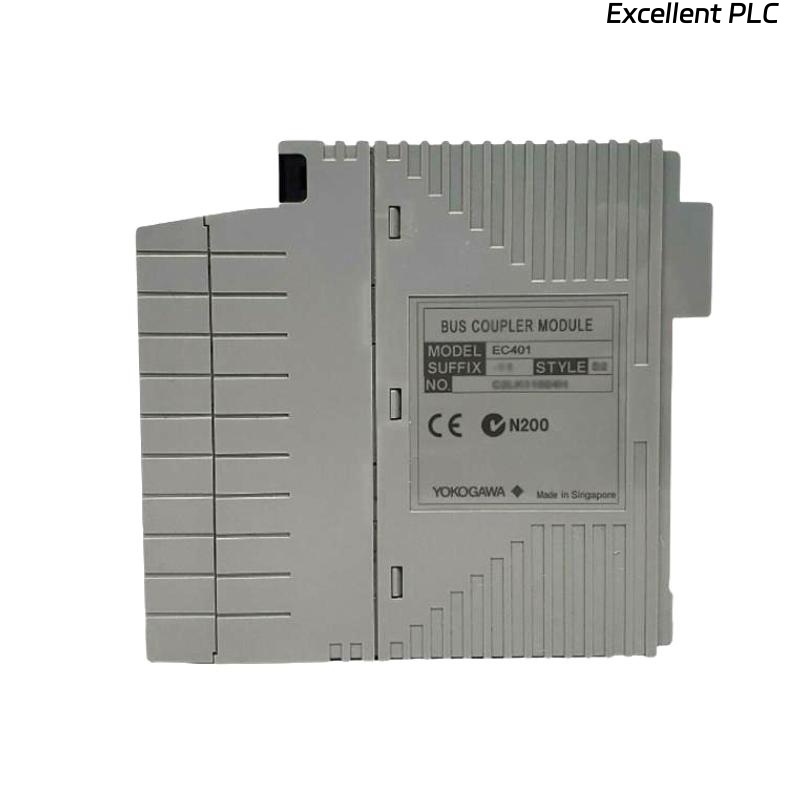
The Yokogawa ANT401 Optical ESB Bus Repeater Master Module is a fiber optic communication module used in Yokogawa CENTUM VP and CENTUM CS 3000 Distributed Control Systems (DCS). It converts electrical ESB (Enhanced Serial Bus) signals into optical signals, enabling long-distance communication between the Field Control Unit (FCU) and remote Field I/O (FIO) nodes through optical fiber. When paired with an ANT502 Optical ESB Bus Repeater Slave Module, the ANT401 extends ESB Bus communication distances up to 5 km while providing excellent immunity to electromagnetic interference (EMI) and complete electrical isolation.
Contents
- 1. Product Overview
- 2. Main Features
- 3. Typical Applications
- 4. Installation Preparation
- 5. Module Installation
- 6. Optical Fiber Wiring
- 7. System Configuration
- 8. Commissioning Procedure
- 9. Functional Verification
- 10. Preventive Maintenance
- 11. Practical Installation Case
- 12. Frequently Asked Questions
Product Overview
The ANT401 operates as the master optical repeater of the Optical ESB Bus. It installs in compatible FCUs, ESB Bus Node Units (ANB10/ANB11), or dedicated Optical ESB Bus Repeater Units (ANT10U). The module converts electrical ESB communication into optical transmission and works together with an ANT502 slave module to provide reliable long-distance communication. Dual-redundant configurations are supported by installing paired ANT401 modules.
Main Features
- Electrical-to-optical ESB Bus signal conversion
- Supports optical transmission up to 5 km
- Dual-redundant communication capability
- Excellent immunity to electromagnetic interference
- Complete electrical isolation
- Supports star or chain optical network architectures
- Compatible with Yokogawa FIO and N-IO systems
- Designed for continuous industrial operation
Typical Applications
- Large refinery automation systems
- Petrochemical plants
- LNG terminals
- Power generation facilities
- Remote instrument buildings
- Offshore platforms
- Long-distance Field I/O installations
- Industrial environments with high electrical noise
Installation Preparation
- Verify the ANT401 model and suffix code.
- Confirm compatibility with the installed FCU or node unit.
- Prepare qualified optical fiber cables.
- Inspect fiber optic connectors.
- Verify cabinet grounding.
- Confirm installation slot assignment.
- Review system engineering drawings.
Module Installation
- Power down the cabinet before installation.
- Insert the ANT401 into the designated slot.
- Secure the module completely.
- Install the ESB connector unit (/CU1N or /CU1T as required).
- Connect the electrical ESB Bus.
- Connect the optical fiber to the paired ANT502 module.
- Verify module locking and cable routing.
Optical Fiber Wiring
- Clean optical connectors before connection.
- Observe the minimum fiber bending radius.
- Separate fiber cables from power cables.
- Verify optical transmit and receive polarity.
- Secure fiber connectors.
- Label all optical communication paths.
System Configuration
- Configure Optical ESB communication.
- Assign remote node parameters.
- Enable communication redundancy if installed.
- Download controller configuration.
- Verify optical link status.
- Review communication diagnostics.
Commissioning Procedure
VERIFY MODULE INSTALLATION
CHECK POWER STATUS
VERIFY ESB CONNECTION
CONNECT OPTICAL FIBER
POWER UP SYSTEM
VERIFY OPTICAL LINK
TEST COMMUNICATION
CONFIRM NORMAL OPERATION
Functional Verification
- Verify optical link establishment.
- Confirm communication with the paired ANT502.
- Verify all remote I/O nodes communicate normally.
- Test redundant communication if installed.
- Review controller diagnostics.
- Monitor communication stability.
Preventive Maintenance
- Clean fiber connectors regularly.
- Inspect optical cables for mechanical damage.
- Verify module seating.
- Review communication alarm history.
- Maintain cabinet cooling.
- Perform scheduled redundancy testing.
Practical Installation Case
During expansion of a refinery control system, engineers installed ANT401 Optical ESB Bus Repeater Master Modules in the Field Control Unit cabinet while placing ANT502 slave modules in remote Field I/O buildings located approximately 3 km away. After fiber installation, communication configuration, and redundancy testing, all remote I/O stations communicated normally with stable optical transmission and no observed EMI-related communication disturbances.
Frequently Asked Questions
What is the primary function of the ANT401?
The ANT401 converts electrical ESB Bus signals into optical signals and acts as the master repeater for long-distance optical ESB communication. It is designed to operate together with an ANT502 Optical ESB Bus Repeater Slave Module.
What communication distance does the ANT401 support?
When paired with an ANT502 slave module, the ANT401 supports Optical ESB Bus transmission distances of up to 5 km using fiber optic cable.
Where can the ANT401 be installed?
The module can be installed in compatible Yokogawa Field Control Units, ESB Bus Node Units (ANB10/ANB11), and dedicated Optical ESB Bus Repeater Units (ANT10U), depending on the system architecture and slot configuration.
Summary
The Yokogawa ANT401 Optical ESB Bus Repeater Master Module provides reliable electrical-to-optical conversion for extending ESB Bus communication over fiber optic networks. Proper installation, clean fiber connections, accurate configuration, and comprehensive commissioning ensure stable long-distance communication, high immunity to electromagnetic interference, and dependable operation in Yokogawa CENTUM Distributed Control Systems.