 Excellent PLC


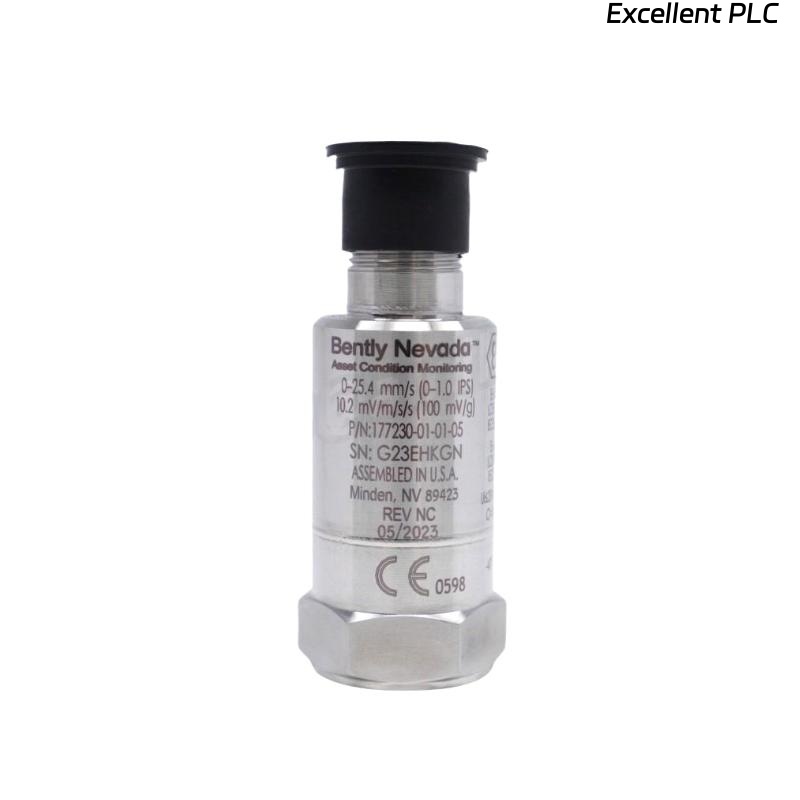
Table of Contents
- Bently Nevada 177230-01-01-00 Installation Guide Entry
- Role of 177230 Seismic Sensor in Machinery Protection Systems
- Mounting Strategy Based on Vibration Transmission Path
- 4–20 mA Loop Integration with PLC and Monitoring Modules
- Hidden Installation Risks in Real Field Conditions
- Commissioning and Signal Validation
- FAQ
- Technical Summary
Bently Nevada 177230-01-01-00 Installation Guide Entry
Bently Nevada 177230-01-01-00 seismic sensor installation problems are most commonly caused by improper mounting stiffness or incorrect current loop configuration, leading to underestimated vibration values rather than sensor failure.
This Installation Guide focuses on mechanical coupling quality, loop stability, and accurate vibration transmission.
Role of 177230 Seismic Sensor in Machinery Protection Systems
- Measures casing vibration (velocity) instead of shaft displacement
- Provides 4–20 mA output proportional to vibration level
- Integrates directly with PLC, DCS, or monitoring modules
The sensor is widely used in pumps, compressors, turbines, and fans to detect imbalance, misalignment, and structural issues. :contentReference[oaicite:0]{index=0}
Mounting Strategy Based on Vibration Transmission Path
- Install directly on rigid machine surfaces (bearing housing preferred)
- Avoid thin covers, guards, or flexible plates
- Ensure flat contact surface and proper torque tightening
- Orient sensor based on measurement direction (radial/axial)
IF vibration reading too low:
    check mounting rigidity
    verify installation location

IF unstable signal:
    inspect mechanical looseness
Engineering Insight: Seismic sensors measure structure-borne vibration; poor mounting reduces energy transfer and leads to false low readings.
4–20 mA Loop Integration with PLC and Monitoring Modules
- Loop-powered operation (12–48 VDC typical)
- Output signal: 4–20 mA proportional to vibration velocity
- Direct connection to PLC analog input or I/O module
IF no output:
    check loop continuity
    verify supply voltage

IF constant 4 mA:
    no vibration detected or wiring issue

IF fluctuating signal:
    check grounding and EMI sources
Proper loop configuration ensures stable signal transmission in industrial environments.
Hidden Installation Risks in Real Field Conditions
- Mounting on painted or uneven surfaces reducing coupling
- Loose stud causing intermittent vibration transmission
- Signal cable routed near high-power cables causing EMI
Real Case:
In a refinery pump system, vibration readings remained below 2 mm/s despite clear mechanical noise. Inspection showed the sensor mounted on a painted surface with poor contact. After surface cleaning and reinstallation, vibration increased to 5.1 mm/s, matching analyzer readings.
Commissioning and Signal Validation
- Verify baseline output (~4–6 mA under low vibration)
- Monitor signal during startup and load increase
- Compare readings with portable vibration analyzer
Commissioning ensures system accuracy and reliability.
FAQ
Why is vibration reading lower than expected?
This is usually caused by poor mounting or incorrect installation location.
Can the sensor connect directly to PLC?
Yes, it outputs a standard 4–20 mA signal.
What is the typical operating temperature?
Usually -40°C to +85°C depending on configuration. :contentReference[oaicite:1]{index=1}
Technical Summary
This Installation Guide highlights that Bently Nevada 177230-01-01-00 sensor performance depends on proper mechanical coupling, correct loop wiring, and stable system configuration. Accurate installation ensures reliable casing vibration monitoring in critical machinery.