 Excellent PLC


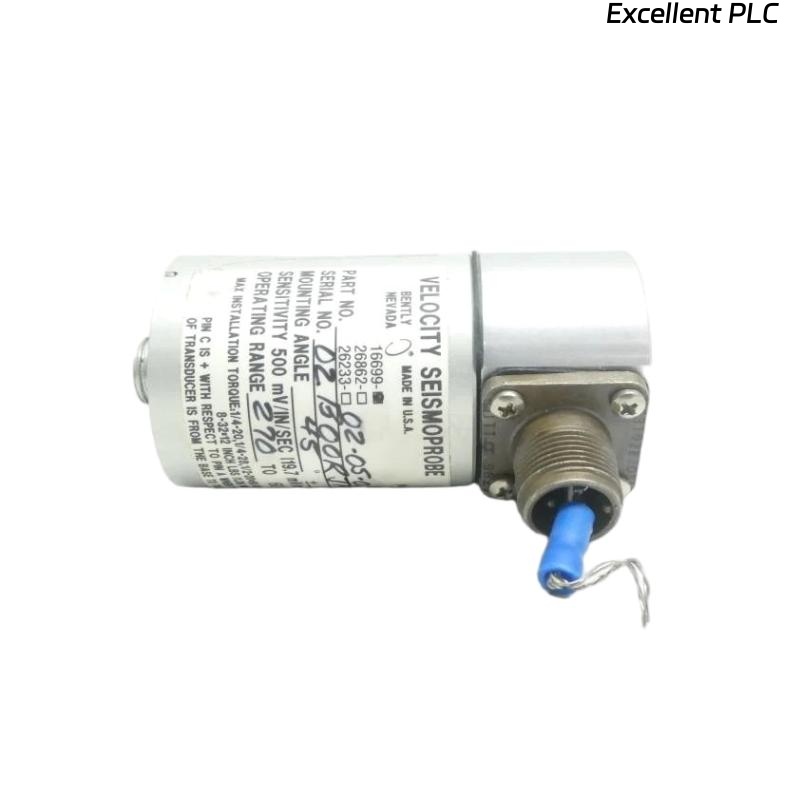
Table of Contents
- Bently Nevada 16699-03-05-03 Troubleshooting Guide Entry
- Vibration Signal Fault Patterns
- Fault Diagnosis Logic for Velocity Sensor
- Common Causes of Sensor Measurement Errors
- Real Case: Low Vibration Detection Issue
- Recovery Strategy and Optimization
- FAQ
- Technical Summary
Bently Nevada 16699-03-05-03 Troubleshooting Guide Entry
Bently Nevada 16699-03-05-03 seismic velocity sensor troubleshooting typically reveals that low or unstable vibration signals are caused by installation conditions, signal interference, or mechanical coupling issues rather than sensor failure.
This guide introduces a practical fault diagnosis process based on vibration signal behavior.
Vibration Signal Fault Patterns
- Unexpectedly low vibration amplitude
- Signal fluctuation or noise spikes
- No output signal
- Inconsistent readings under load
Different patterns indicate different fault origins.
Fault Diagnosis Logic for Velocity Sensor
IF vibration too low:
    check mounting surface
    verify sensor coupling

IF signal noisy:
    inspect cable shielding
    check EMI sources

IF unstable readings:
    verify mounting stability
    check mechanical looseness

IF no signal:
    test wiring continuity
    verify sensor integrity
This structured logic supports efficient troubleshooting.
Common Causes of Sensor Measurement Errors
- Poor mechanical coupling to machine surface
- Incorrect installation location
- Electrical noise interference
- Loose mounting or misalignment
Real Case: Low Vibration Detection Issue
In a compressor system, vibration readings were consistently below alarm threshold despite known mechanical issues.
Analysis:
- Measured value: 1.5 mm/s
- Expected: ~5 mm/s based on machine condition
Root Cause: Sensor mounted on flexible bracket causing damping.
Solution:
- Relocated sensor to rigid bearing housing
- Improved mounting method
Result: Vibration reading increased to 4.8 mm/s, accurately reflecting machine condition.
Recovery Strategy and Optimization
- Ensure rigid mounting surface
- Optimize sensor placement near critical components
- Improve cable shielding and routing
- Validate signal under operating conditions
Proper troubleshooting restores measurement accuracy.
FAQ
Why is vibration reading lower than expected?
Usually due to poor mounting or damping effects.
How to eliminate signal noise?
Improve cable shielding and avoid EMI sources.
Is sensor replacement necessary?
Not typically; most issues are installation-related.
Technical Summary
This Troubleshooting Guide shows that Bently Nevada 16699-03-05-03 sensor issues are mainly caused by installation and environmental factors. A structured fault diagnosis approach ensures reliable vibration monitoring.