 Excellent PLC


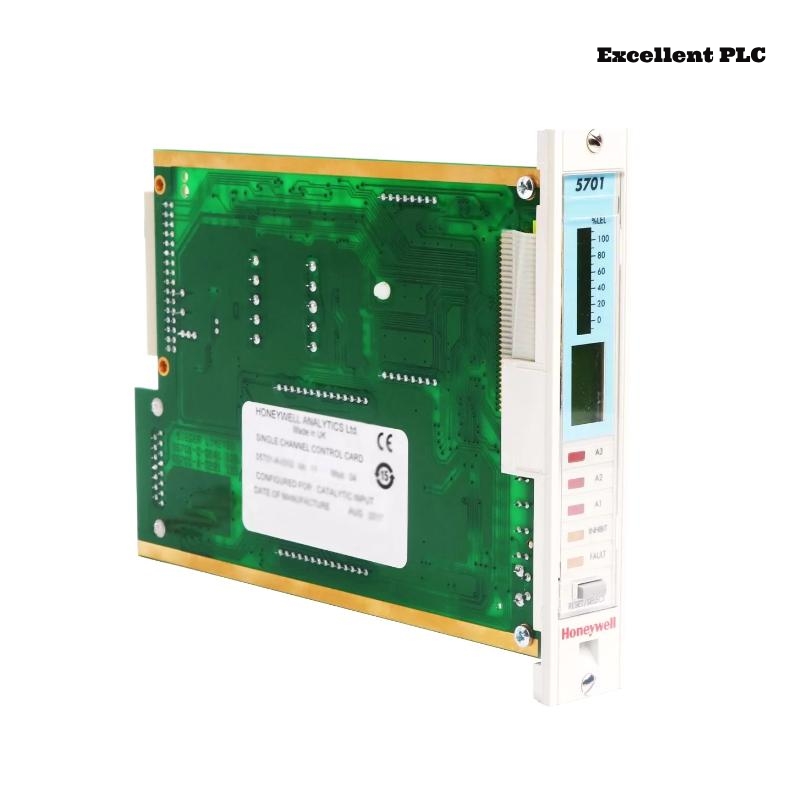
The Honeywell 05701-A-0302 Single Channel Control Card Catalytic is a critical control component in the Honeywell System 57 Gas Detection Controller. It processes signals from catalytic gas sensors, displays combustible gas concentration values, manages alarm functions, and provides diagnostic monitoring. During long-term industrial operation, problems such as unstable readings, calibration failures, sensor faults, alarm errors, or channel failures may occur due to sensor aging, wiring problems, configuration errors, power supply issues, or control card faults. A structured troubleshooting procedure helps maintenance engineers quickly identify the cause and restore reliable gas detection performance.
Contents
- 1. Understanding Control Card Faults
- 2. Common Failure Symptoms
- 3. Typical Causes
- 4. Initial Hardware Inspection
- 5. Catalytic Sensor Verification
- 6. Diagnostic Analysis
- 7. Recommended Troubleshooting Workflow
- 8. Corrective Actions
- 9. Functional Recovery Verification
- 10. Preventive Maintenance
- 11. Industrial Maintenance Case
- 12. Frequently Asked Questions
Understanding Control Card Faults
The Honeywell 05701-A-0302 processes signals from catalytic gas detection sensors and controls a single monitoring channel within the System 57 platform. The card continuously monitors sensor input, gas concentration levels, alarm thresholds, and channel health status. Fault conditions may be caused by catalytic sensor degradation, incorrect calibration, unstable power supply, damaged wiring, poor connections, incorrect configuration parameters, or internal electronic failure.
Common Failure Symptoms
- No gas concentration displayed.
- Gas reading remains unstable.
- Zero calibration cannot be completed.
- Span calibration fails.
- False combustible gas alarms occur.
- Channel fault indication appears.
- Sensor response is slow or incorrect.
- Alarm outputs do not activate.
Typical Causes
- Aged catalytic sensor element.
- Poisoned or contaminated sensor.
- Incorrect sensor calibration.
- Open circuit or short circuit wiring.
- Loose sensor connections.
- Incorrect detector configuration.
- Unstable power supply.
- Damaged control card connector.
- Internal control card failure.
Initial Hardware Inspection
- Check System 57 power supply status.
- Inspect the 05701-A-0302 front indicators.
- Confirm the card is correctly installed.
- Inspect rack connectors.
- Check catalytic sensor connections.
- Review fault indications.
Catalytic Sensor Verification
- Verify sensor bridge wiring.
- Check detector resistance values.
- Inspect sensor condition.
- Confirm calibration gas specification.
- Perform zero calibration.
- Perform span calibration.
- Verify sensor response time.
Diagnostic Analysis
| Observed Condition | Possible Diagnosis |
|---|---|
| No gas display | Power failure, sensor wiring fault, or control card problem |
| Reading unstable | Sensor aging, loose wiring, or environmental interference |
| Calibration failure | Sensor degradation, incorrect calibration gas, or wiring fault |
| False alarms | Sensor contamination, incorrect settings, or unstable signal |
| Fault alarm active | Sensor circuit failure or card diagnostic error |
Recommended Troubleshooting Workflow
CHECK SYSTEM FAULT STATUS
VERIFY POWER SUPPLY
INSPECT SENSOR CONNECTIONS
CHECK CATALYTIC SENSOR CONDITION
VERIFY CALIBRATION SETTINGS
TEST ALARM FUNCTIONS
CHECK CONTROL CARD OPERATION
CONFIRM NORMAL OPERATION
Corrective Actions
- Restore stable controller power.
- Reseat the control card.
- Repair damaged sensor wiring.
- Clean contaminated sensor heads.
- Replace aged catalytic sensors.
- Perform correct zero and span calibration.
- Correct detector configuration parameters.
- Replace the control card after confirming internal failure.
Functional Recovery Verification
- Confirm accurate gas concentration display.
- Verify sensor response to calibration gas.
- Check A1/A2/A3 alarm operation.
- Verify fault indication clears.
- Confirm relay outputs operate correctly.
- Monitor channel stability after repair.
Preventive Maintenance
- Perform scheduled catalytic sensor calibration.
- Inspect sensor wiring regularly.
- Keep detector heads clean.
- Review alarm history.
- Inspect control card connectors.
- Maintain stable power supply conditions.
Industrial Maintenance Case
A chemical plant reported repeated combustible gas alarms from one System 57 detection channel. Engineers inspected the Honeywell 05701-A-0302 control card and confirmed that the card diagnostics were normal. Further inspection found that the catalytic sensor had been exposed to chemical contaminants, causing unstable sensitivity and incorrect gas readings.
After replacing the damaged sensor, completing zero and span calibration, verifying alarm thresholds, and testing the channel response:
- Gas readings returned to normal.
- False alarms were eliminated.
- Alarm functions operated correctly.
- The gas detection channel resumed reliable monitoring.
Frequently Asked Questions
Why does the 05701-A-0302 show unstable gas readings?
Possible causes include catalytic sensor aging, contamination, poor wiring connections, electrical interference, incorrect calibration, or unstable power supply.
Why does catalytic sensor calibration fail?
Calibration failures are usually caused by incorrect calibration procedures, expired calibration gas, damaged sensors, wiring faults, or incorrect configuration settings.
When should the 05701-A-0302 control card be replaced?
The card should only be replaced after confirming that the catalytic sensor, wiring, power supply, calibration process, and configuration parameters are correct while the control card continues to report internal faults or abnormal operation.
Summary
Effective troubleshooting of the Honeywell 05701-A-0302 Single Channel Control Card Catalytic requires systematic inspection of sensor condition, wiring integrity, calibration settings, power supply quality, alarm configuration, and diagnostic information. Regular sensor maintenance and functional testing help ensure reliable combustible gas detection and long-term safety system performance.