 Excellent PLC


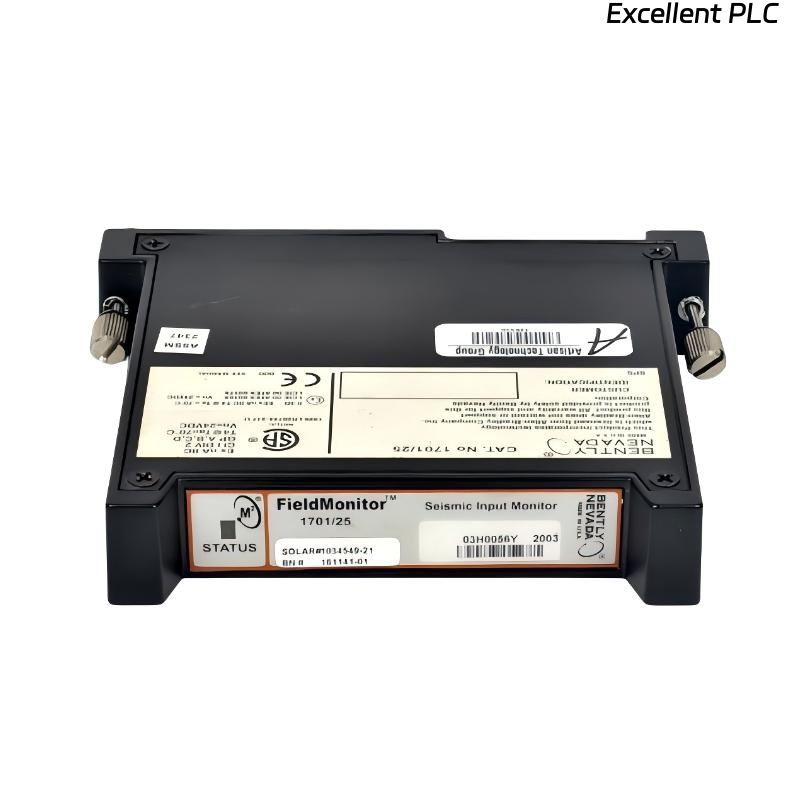
Table of Contents
- Bently Nevada 1701/25 Installation Guide Entry
- Role of Seismic Input Monitor Module in Monitoring Systems
- Engineering Approach to Seismic Signal Integration
- Sensor Wiring and Input Channel Setup
- System Configuration and Signal Scaling
- Commissioning and Signal Validation
- FAQ
- Technical Summary
Bently Nevada 1701/25 Installation Guide Entry
Bently Nevada 1701/25 seismic input monitor module installation errors often lead to inaccurate vibration velocity readings due to incorrect sensor wiring, improper signal scaling, or grounding issues rather than module malfunction.
This Installation Guide focuses on achieving reliable seismic signal acquisition and stable monitoring system configuration.
Role of Seismic Input Monitor Module in Monitoring Systems
- Receives signals from seismic velocity sensors
- Converts vibration velocity into usable monitoring data
- Interfaces with PLC and system configuration platforms
Accurate signal acquisition is critical for machinery protection.
Engineering Approach to Seismic Signal Integration
- Ensure compatibility between sensor output and module input range
- Install module in low-noise environment
- Separate signal wiring from power circuits
- Implement proper grounding strategy
Field Insight: Signal mismatch between sensor and module is a frequent installation issue.
Sensor Wiring and Input Channel Setup
- Connect seismic sensor output to designated input channel
- Verify signal type (velocity output, typically mV/mm/s)
- Ensure correct polarity and shielding connection
- Secure wiring terminals to avoid intermittent signals
Incorrect wiring leads to unstable or missing signals.
System Configuration and Signal Scaling
- Configure module input range according to sensor specification
- Set correct scaling factors in monitoring system
- Verify unit consistency (mm/s or in/s)
IF signal too low:
    check sensor sensitivity
    verify scaling configuration

IF noisy signal:
    inspect grounding
    verify cable shielding

IF no signal:
    check wiring continuity
    verify sensor output
Real Case:
In a pump monitoring application, vibration velocity readings were significantly lower than expected (1.2 mm/s vs expected 4 mm/s). Investigation revealed incorrect scaling configuration in the module. After correcting scaling parameters, readings increased to 3.9 mm/s and aligned with actual machine condition.
Commissioning and Signal Validation
- Measure sensor output under operating conditions
- Verify stable signal transmission to system
- Compare readings with reference measurement tools
Commissioning ensures reliable system performance.
FAQ
Why is vibration velocity reading incorrect?
This is often caused by incorrect scaling or sensor mismatch.
Can wiring affect seismic signal quality?
Yes, improper wiring introduces noise and instability.
How to ensure correct system configuration?
Match module settings with sensor specifications and verify scaling.
Technical Summary
This Installation Guide highlights that Bently Nevada 1701/25 seismic input monitor module performance depends on correct wiring, accurate scaling, and proper grounding. Proper installation ensures reliable vibration monitoring in industrial systems.