 Excellent PLC


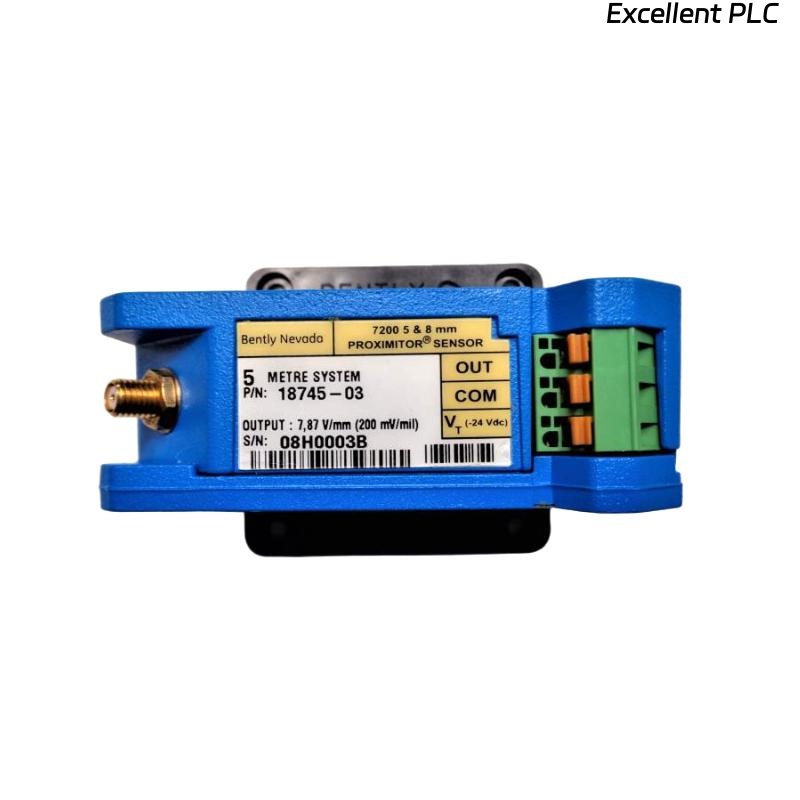
Table of Contents
- Bently Nevada 18745-03 Troubleshooting Entry
- Fault Diagnosis Logic for Proximity Systems
- Signal Symptoms and Engineering Interpretation
- Root Cause Analysis in 7200 Proximitor Systems
- Real Case: Gap Voltage Drift Failure
- Recovery Strategy and Optimization
- FAQ
- Technical Summary
Bently Nevada 18745-03 Troubleshooting Entry
Bently Nevada 18745-03 Proximitor sensor troubleshooting reveals that abnormal gap voltage, unstable vibration readings, or signal saturation are typically caused by probe installation errors or system mismatch—not sensor failure.
This guide focuses on diagnosing faults through voltage and signal behavior.
Fault Diagnosis Logic for Proximity Systems
Use this engineering sequence:
- Measure gap voltage
- Verify system configuration
- Inspect probe mounting
- Analyze dynamic signal
This approach isolates faults efficiently.
Signal Symptoms and Engineering Interpretation
IF gap voltage > -5V:
    probe too far from shaft

IF gap voltage < -15V:
    probe too close

IF signal saturated:
    wrong calibration or mismatch

IF signal noisy:
    EMI or grounding issue
Key Insight: Gap voltage is the fastest way to identify installation faults.
Root Cause Analysis in 7200 Proximitor Systems
- Incorrect probe gap setting
- 5 m / 9 m system length mismatch
- Wrong probe diameter configuration
- Cable or connector degradation
The system measures both static and dynamic displacement, making it highly sensitive to installation accuracy. :contentReference[oaicite:3]{index=3}
Real Case: Gap Voltage Drift Failure
In a centrifugal compressor system, vibration alarms triggered unexpectedly.
Observed Data:
- Gap voltage drifted from -10 V to -4 V during operation
Analysis: Mechanical shift suspected.
Root Cause: Probe mounting loosened due to thermal expansion.
Solution:
- Re-tightened probe mounting
- Re-adjusted gap position
Result: Gap voltage stabilized at -9 V, alarms cleared.
Recovery Strategy and Optimization
- Maintain correct probe gap during operation
- Ensure full system compatibility
- Inspect connectors and cables periodically
- Implement EMI shielding best practices
Preventive diagnostics reduces unexpected downtime.
FAQ
What is the normal gap voltage range?
Typically between -8 V and -12 V for optimal linear measurement.
Why is vibration reading too high?
This is often caused by probe mismatch or incorrect calibration.
Is Proximitor failure common?
No, most issues are related to installation or system configuration.
Technical Summary
This Troubleshooting Guide confirms that Bently Nevada 18745-03 faults are primarily caused by installation errors, system mismatch, and environmental factors. A structured diagnostic approach ensures accurate and stable monitoring performance.