 Excellent PLC


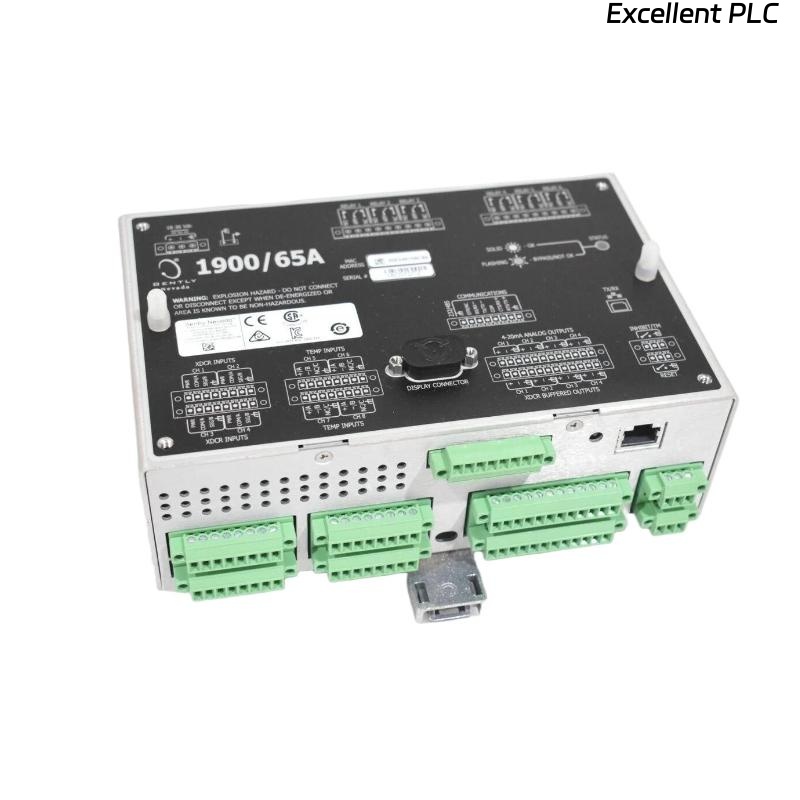
Bently Nevada 1900/65-00-00-01-00-00 General Purpose Equipment Monitor Installation Guide for Integrated System Configuration
Table of Contents
- Why 1900/65 Installation Fails in Integrated Systems
- Observed Issues During System Integration
- Signal Conflict Between Monitor and PLC
- Rebuilding the Monitoring Architecture
- System Configuration and Signal Alignment
- Validation Using Multi-Channel Data
- 1900/65 Installation Best Practices
- FAQ
- Technical Summary
Why 1900/65 Installation Fails in Integrated Systems
Bently Nevada 1900/65-00-00-01-00-00 installation problems often appear when integrating with PLC or DCS systems. The monitor itself works, but conflicts arise when multiple systems interpret the same signal differently.
Observed Issues During System Integration
In a pump station monitoring project:
- 1900/65 monitor displayed stable vibration
- PLC received fluctuating 4–20 mA signal
- Alarm logic inconsistent between systems
This created confusion in system operation.
Signal Conflict Between Monitor and PLC
Investigation revealed:
- Monitor output scaled 0–50 mm/s
- PLC configured as 0–100 mm/s
Result:
- PLC interpreted signal incorrectly
- Displayed values doubled actual vibration
IF scaling_monitor != scaling_PLC:
    data_mismatch = TRUE
    alarm_logic = invalid
Rebuilding the Monitoring Architecture
Instead of adjusting only one side, we redefined the entire signal chain:
- Sensor → 1900/65 monitor → standardized 4–20 mA
- PLC configured to match monitor scaling
- Alarm handled primarily at monitor level
This ensured consistency across systems.
System Configuration and Signal Alignment
- Defined engineering unit (mm/s)
- Set identical scaling in monitor and PLC
- Verified analog signal linearity
Measured output:
- 4 mA = 0 mm/s
- 20 mA = 50 mm/s
Validation Using Multi-Channel Data
Validation included:
- Monitor display vs PLC display comparison
- Manual vibration measurement
Final data:
- Monitor: 26 mm/s
- PLC: 25.5 mm/s
Error reduced to within acceptable range.
1900/65 Installation Best Practices
- Always align scaling between systems
- Define a single source of truth for alarms
- Validate signal at both monitor and PLC levels
- Document configuration clearly
FAQ
Why does PLC show different values than 1900/65 monitor?
This is usually caused by scaling mismatch between the monitor output and PLC configuration.
Should alarms be handled by PLC or monitor?
It is recommended to use the monitor as the primary alarm source for consistency.
Technical Summary
Bently Nevada 1900/65-00-00-01-00-00 installation in integrated systems requires careful signal alignment and architecture design. Field experience shows that scaling mismatch is a common source of error. A unified configuration strategy ensures consistent data interpretation and reliable monitoring performance.