 Excellent PLC


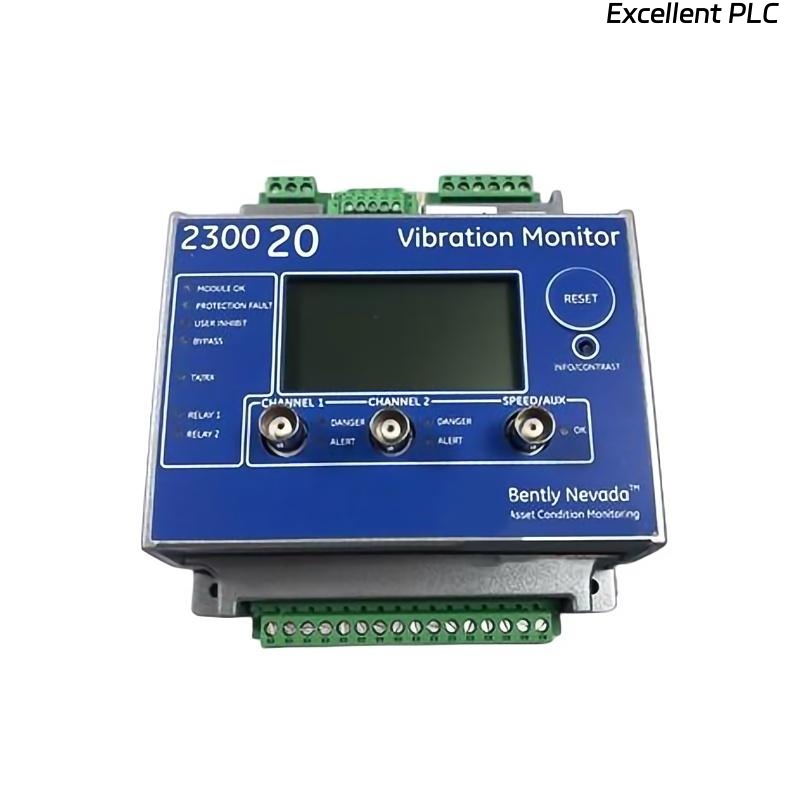
Table of Contents
- 2300/20 Vibration Monitor Installation Overview
- 2300/20 Vibration Monitor Application in Machinery Protection
- Control Cabinet Preparation and Installation Planning
- Sensor Wiring and Input Configuration
- 2300/20 Monitor Setup and System Configuration
- Machinery Protection Commissioning Procedure
- Dynamic Signal Validation and Alarm Testing
- Real Compressor Commissioning Experience
- Installation FAQ
- Final Engineering Summary
2300/20 Vibration Monitor Installation Overview
Bently Nevada 2300/20 vibration monitor installation quality directly affects machinery protection reliability and vibration alarm accuracy. In rotating equipment systems, incorrect sensor wiring, improper alarm configuration, and grounding problems frequently cause unstable monitoring behavior during startup.
This Installation Guide explains practical Setup methods for vibration monitor mounting, signal input configuration, alarm logic adjustment, and machinery protection Commissioning.
2300/20 Vibration Monitor Application in Machinery Protection
- Monitors shaft vibration and machinery condition
- Provides alarm and shutdown protection functions
- Interfaces with PLC Controller and DCS systems
- Supports compressors, turbines, pumps, and motors
Control Cabinet Preparation and Installation Planning
- Verify cabinet grounding continuity before installation
- Separate vibration signal wiring from power cables
- Inspect environmental temperature and ventilation
- Ensure adequate panel spacing for heat dissipation
Sensor Wiring and Input Configuration
Stable vibration monitoring depends heavily on proper sensor signal routing and shielding continuity.
- Connect vibration probes using shielded cable
- Verify sensor polarity before startup
- Maintain single-point grounding strategy
- Label monitoring channels clearly for diagnostics
  // Sensor Input Validation
  IF Signal_Input_Noise > Threshold THEN
      Inspect_Shielding();
      Verify_Grounding();
  ELSE
      Continue_System_Setup();
  END_IF;
2300/20 Monitor Setup and System Configuration
- Configure vibration alarm thresholds
- Adjust shutdown relay timing parameters
- Verify monitoring channel scaling values
- Check PLC Controller communication signals
Machinery Protection Commissioning Procedure
- Observe vibration trends during startup
- Verify monitor response at rated speed
- Check alarm and shutdown relay operation
- Validate communication with DCS or PLC systems
Dynamic Signal Validation and Alarm Testing
- Compare vibration values across channels
- Monitor waveform stability under load changes
- Record baseline vibration levels for future Troubleshooting
- Verify transient response during acceleration
Real Compressor Commissioning Experience
During commissioning of a refinery compressor protection system, unstable vibration alarms occurred during startup:
- Vibration values fluctuated between 3 mm/s and 11 mm/s
- Alarm relay activated intermittently during acceleration
We observed that signal grounding was connected at multiple cabinet points, creating ground loop interference.
After corrective actions:
- Implemented single-point grounding
- Improved shield termination and cable routing
Result:
- Stable vibration monitoring restored
- False alarms eliminated during operation
Installation FAQ
Why is single-point grounding important for vibration monitors?
Multiple grounding points may create ground loop interference and unstable monitoring signals.
Can power cable routing affect vibration monitoring accuracy?
Yes. Signal cables routed near inverter wiring may experience EMI interference.
Should alarm relays be tested during commissioning?
Yes. Alarm and shutdown logic verification is critical for machinery protection reliability.
Final Engineering Summary
The Bently Nevada 2300/20 Installation Guide demonstrates that reliable vibration monitoring depends on correct System Configuration, stable grounding, proper signal wiring, and accurate machinery protection Commissioning.